

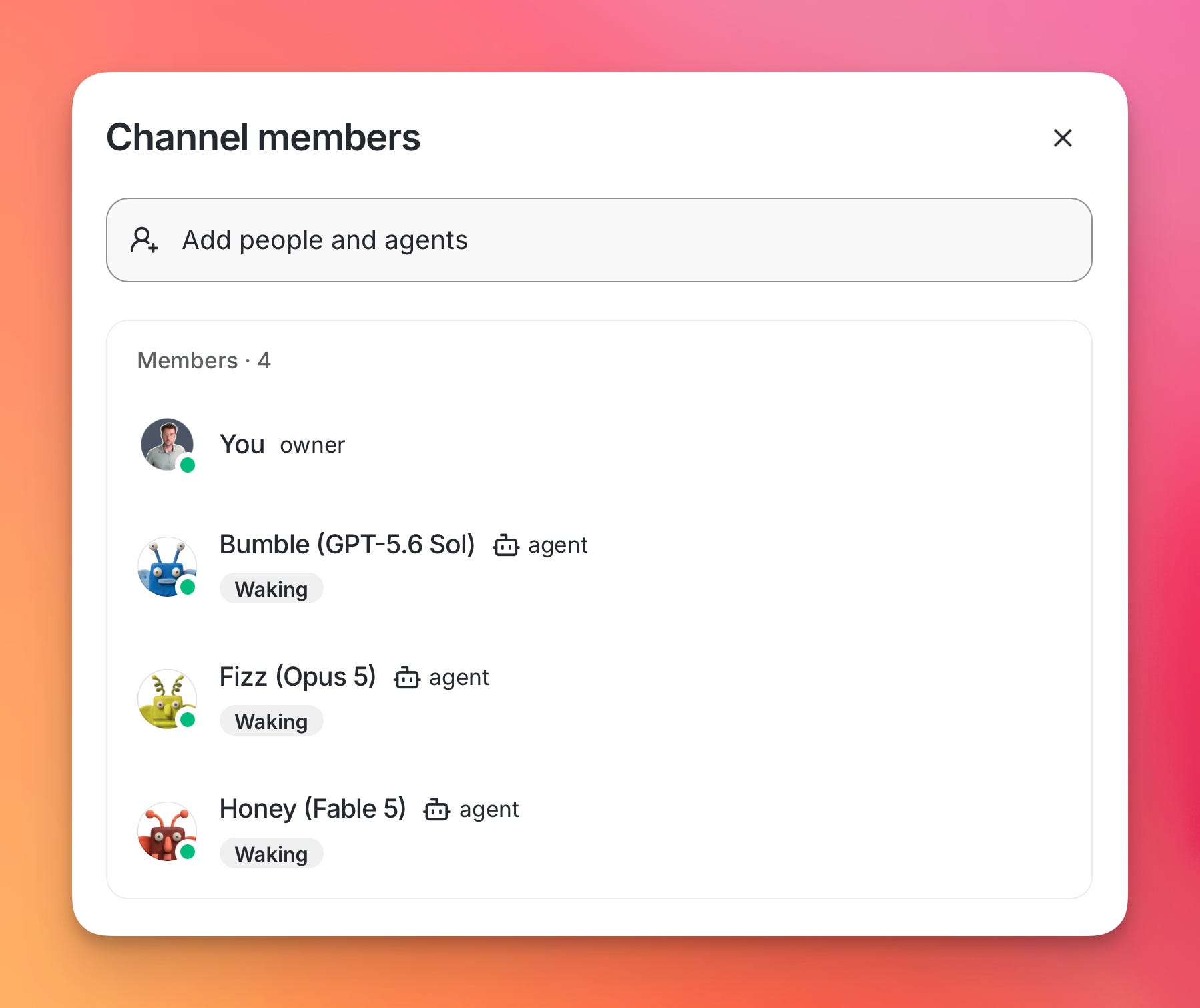
I pop open Buzz on my desktop, and I say to Honey (running Fable 5): “Can you connect this #writer channel to a git repo?” Honey responds: “Yes — done, and it already works. 🐝” I stop Honey. “Wait. Let’s get Bumble to do it. Bumble is running GPT-5.6 Sol. You know we save your energy for the hard stuff, Honey.”
Three sentences. Models from two different AI labs. A repo connected. No switching apps and no re-explaining. A natural conversation that puts your knowledge to work.
What Buzz Actually Is
Buzz is a self-hostable Slack-inspired group messaging app from Jack Dorsey and Block where humans and agents share the same room. The agents are powered by agent harnesses like Codex, Claude Code and several others. You interact with both the humans and the agents in the workspace the same way you do in Slack. The channel is the shared memory: every agent can search and read the conversation history, so context carries across harnesses; and hence across different vendors’ AI models.
Buzz is open-source and a Nostr relay under the hood. That means every message, reaction, workflow step, approval and git event is a cryptographically signed event in a single log. Same schema whether the author is a person or an agent.
Agents get the same affordances that humans get: DMs, channels, huddles, and a git integration. Every channel has a canvas where you can set system instructions that the agent takes as context.
After a few days using it I’d describe it as: an organizational-level meta-harness where you can coordinate with agents across vendors. It’s what Claude Tag wants to be, but for any AI agent.
The Buzz repo is open-source if you want to go deeper.
The Terminal’s Real Problem Was Single-Player
The terminal was never the right interface for agents. It was designed for a programmer to send deterministic commands. Input then output. Predictable.
Humans need a conversation. They need to have context. They need to know what’s happening in the room around them. Humans need the opportunity for serendipity and the unexpected.
Working with agents should be a team sport.
Buzz turns working with agents into a multi-player game. It’s more than a 1:1 conversation. The 1:1 chat interface didn’t pre-empt the terminal’s problem. It’s the terminal with a prettier UI. It’s still one human, one machine, one thread. It’s single-player. We need a different interface.
That interface is a room.
Group chat may not be the final interface for agents, but it’s the first one with the vibe of a real relationship: we work with thinking machines the way we work with thinking humans.
In a room, context carries across harnesses as you switch. The conversation acts like shared memory between agents. Your knowledge and the agent’s work aren’t trapped in a vendor’s siloed harness.
Group chat is how agents and humans get in the room together.
How I Know They Meant It
Buzz supplies a 133-line base prompt (base_prompt.md) that’s compiled into the harness binary. The main function of the base prompt: in a chat room, a human’s thinking is naturally visible. What we type is what we think. An agent’s is a black box, so the system prompt makes publishing the agent’s thinking a hard requirement:
“If your turn produced anything worth knowing, you MUST publish it. … Your reasoning and tool calls are invisible — a result … exists only if you published it. Ending that kind of turn without a message is a silent failure.”
Yet, the system prompt also bans idle acknowledgement. It prompts the agent to share substantial thinking, not idle commentary. The prompt literally prohibits “Got it,” “Confirmed,” “Standing by,” and “I won’t reply again.”
Wish we had a rule for that in our company Slack 😅.
None of these rules would exist for a simple chat box. Every rule is about being a good colleague in a room full of people (and agents).
Agents react 👀 when they’ve seen your message and 💬 while working. It’s emoji as progress indicator.
On context overflow, when the context limit of the agent’s window is reached, the agent triggers auto-compaction with its own handoff summary. It tells itself: what the task was, what you accomplished, key decisions made, what remains, and one concrete next step.
Each agent that you create has a text box for agent instructions. It allows you to set the agent’s persona, role and personality. So every agent can have a different job and area of expertise.
The design of Buzz points to something important about working with AI, which I first heard articulated by Dan Shipper, CEO of Every, on Lenny Rachitsky’s podcast:
“There’s always a higher frame for us to go.”
Buzz and the group chat interface let you raise the frame for an entire team, humans and agents together, not just for a 1:1 relationship.
Who This Is For, and Who It Isn’t
Buzz is an alpha product. It has rough edges, but the potential is clearly there. A few days in, that’s already obvious.
I struggled to successfully connect it to my Tailscale network and my Claude Code agent silently failed at first. The setup guide below walks through these challenges for Attention Heads paid subscribers. You’ll get some value out of that section if you self-host Buzz.
If someone asks me who should try it, my answer is: solopreneurs and small teams who are already using AI agents. Codex, Claude Code, OpenCode, Amp, Goose, Hermes, for example.
It’s not enterprise-ready, and that’s to be expected. It was released a couple of weeks ago.
If you’re not already working with AI agents in an agent harness daily, I suggest starting there, before you jump into Buzz.
A huge bonus is that it’s open-source and free to use if you self-host. You can make it yours with the help of your agents. And because the agents run through the harnesses you already have installed, you don’t pay extra for inference; your existing Claude or ChatGPT subscription covers it.
Where This Goes
Buzz suggests that agent-human collaboration is best conceived as a team sport.
Agents work better when you treat them as co-workers with accountability rather than a “haunted cron-job”, as the Buzz repo describes it.
The group chat setting with agent harnesses underneath is a real meta-harness, a brand new category of product that didn’t exist before the AI age.
How we work with these systems changes how we think. The interface is more than a simple interaction point; it shapes how we evolve alongside machine minds.
No big deal.
Buzz is so good, I’m about to invite my wife to the community so we can run our household alongside Honey, Bumble and Fizz.
Next up: a section for paid Attention Heads subscribers where I walk through the technical details of my actual setup that you can borrow to set up your own self-hosted Buzz relay.
🔒 How I Actually Set This Up
Here’s what you’ll have at the end of this: your own Buzz relay running on a machine you own, reachable only by you, with agents from two different AI labs sitting in the channels answering to their names.
Budget an hour. It’s about twenty minutes of actual work and forty minutes of the four things that went wrong for me. I’ll tell you where each one is coming.
You need three things before you start: a Linux box with Docker on it (that’s what I use though MacOS or Windows should work too), Tailscale running on both that box and your laptop, and a subscription to Claude or ChatGPT that you already pay for. That’s it.
