

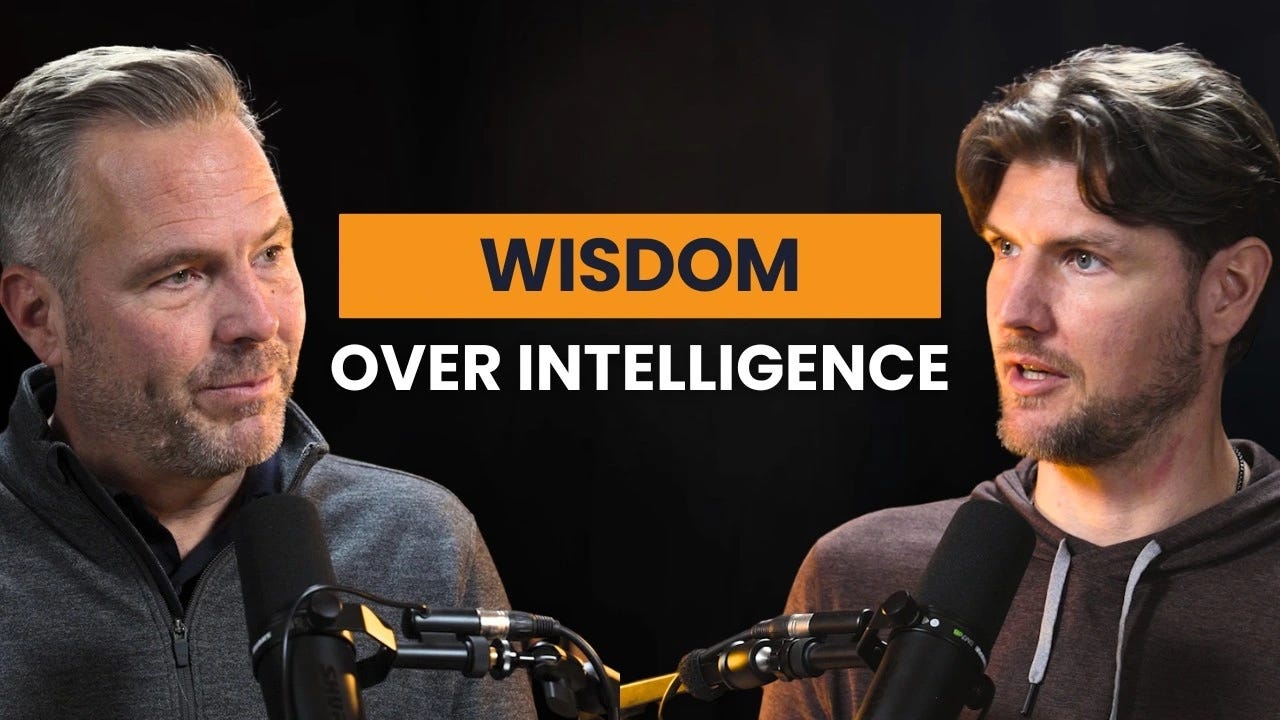
We spent the last hundred years training ourselves to become computers. The modern school system was designed to produce cogs in a machine, and then cogs in an abstract information machine: humans who could calculate, categorize, file, and follow procedure with machine-like reliability. We got very good at it. So good, in fact, that we eventually built actual computers. Now those computers are becoming excellent at the very thing we spent generations imitating.
This is the moment everyone is freaking out about. If the machines can do the machine-work, what is left for us?
I listened to Joe Hudson on his “Art of Accomplishment” podcast recently, in an episode about how to succeed in the age of AI, and it is sage advice. What is left for us is everything we set aside in order to become machines in the first place. Not a bad promise.
I want to walk through his ideas, because it is very much in the lane of what Attention Heads is all about: the age of AI is not primarily a technical challenge. It is a contemplative one.
The ladder
Hudson traces a simple progression. For most of history, societies rewarded physical strength. Then strength was mechanized, and they rewarded skills. Then skills were industrialized, and they rewarded intellect—the credentialed, symbol-manipulating, test-scoring kind. Each rung of the ladder was the scarce asset of its era, and each one was eventually commoditized by technology.
Intellect is being commoditized right now. You can rent it for twenty dollars a month, and the price is falling.
Wisdom is the next rung, and Joe’s feeling is that it differs from every rung below it. Strength, skills, and intellect are assets you possess. Wisdom is a way of being. That difference in kind is the entire reason it cannot be outsourced. The obstacle is a matter of principle rather than a limitation of the current models, and no amount of scaling or algorithmic breakthroughs will cross it.
What wisdom actually is
Hudson tells a story about his daughters. While his nieces were learning three languages by age six, his own kids weren’t yet reading in one, because he and his wife had bet their education on something else: teaching them to be themselves, to have their own will, to know how to be with what they feel. He worried he was ruining them. A friend settled it with one sentence.
Joe’s friend said:
You can hire someone to speak a language for you, but you can’t hire someone to be yourself.
That sentence is this whole essay, really. Everything below it is unpacking.
Because notice what AI can now do: write your emails, speak your languages, summarize your reading, draft your code. And notice what it cannot do. It cannot make the decision about whether you’re going to scroll all day. It cannot make the decision about whether you’re going to get addicted to it. It cannot decide what kind of relationship you’re going to have with your Mom, or your spouse, or your kids. Those decisions have no market, no API, and no delegation path. They are yours alone, and the sum of them is your life.
No AI can be you for you.
Joe gives wisdom three working markers.
Can you see the patterns behind yourself and others?
Can you feel the difficult thing instead of fleeing it?
Can you walk into what everyone else is avoiding because they’re afraid?
The part Joe never makes explicit
Read that list again slowly. Seeing the patterns behind yourself. Feeling the difficult thing. Walking toward what is being avoided.
That is a description of contemplative practice. It is arguably the definition of contemplative practice. At least what I would call “real” contemplative practice. It’s the practice of becoming wiser.
Seeing your own patterns is what every tradition of self-observation trains, whether you call it vipassana, self-inquiry, or examination of conscience. Feeling the difficult thing is the entire point of sitting still when everything in you wants to move. Walking into what others avoid is the renunciation at the heart of any serious path. The hard conversation is a koan you live instead of contemplate.
For most of history, contemplative practice looked like opting out of the economy. The monastery was where you went when you were done competing. Joe’s argument, translated, is that this has now inverted: the meditation cushion turns out to be the training facility for the one capacity the economy cannot buy.
And there is a deeper layer here that I find genuinely stunning. I’ve written before that enlightenment is the realization that thoughts are representations—useful, powerful, world-building representations, but never the absolute truth—whether those thoughts arise in biological minds or silicon ones.
Crucially, the thoughts you have about who you are turn out to be ultimately empty of reality.
For most of my life that was a metaphysical claim you had to take on faith or verify slowly on a cushion. The age of AI has made it obvious. The thinking layer now demonstrably runs outside your skull, on a server, at scale, for anyone. If you are your thoughts, then as of this decade you are purchasable.
If you are the awareness that notices thoughts (hint: you are), chooses among them, and feels their consequences…that was never for sale, and it just became the scarcest resource in the economy.
The three games
Hudson predicts companies will come to resemble NBA organizations: what once took ten thousand people will take two or three hundred, which makes each of those people enormously consequential.
And what makes them consequential is no longer what they know, since knowledge is now rented. He breaks the remaining edge into three games:
The outer game is the body: can you eat, sleep, and endure well enough to play long?
The inner game is your self-talk: can you get out of your own way and let yourself perform?
The third is the team game: can this small group of humans have the hard conversation before it costs three years and the company?
I’d keep all of this in its place: it is evidence for the thesis, and downstream of it. But the team game deserves one contemplative note. Hudson describes CEOs at his councils discovering “the feeling of family” with their teams and recognizing it instantly as a competitive advantage. There is an old word for a community of people committed to doing the inner work together, honestly, in each other’s presence. The monasteries never forgot what a sangha is worth. The boardrooms may rediscover it under boardroom pressure.
What is actually at stake
Hudson retells a story about an indigenous community encountering industrial life. Their host left for work eight hours a day. They asked him why. To take care of my family, he said. Do you like work more than your family? No, I like my family more. Then why do you leave them? To buy a house. The visitors were confused. Where they came from, if somebody needs a house, everyone gathers and builds them a house, and then the family lives in it, together.
We have lived so long inside the arrangement that confused this guest that we forgot it was an arrangement. We normalized abandoning presence to purchase survival, and then we built a value system that measures a person by the quality of their abandonment.
In the podcast, Joe’s co-host Brett says that this is what the fear of AI job loss is actually telling us. The fear is accurate, but it is an accurate reading of our value system, not of the technology. People are correctly observing that a society which only values them for their productivity has no obvious place for them when productivity is automated. The dysfunction being revealed was there all along. And underneath it sits the affliction I believe runs deeper in humanity than any other: fear itself. AI pessimism is just fear’s newest costume, and it is worth saying plainly that the danger in this transition comes from us, from what we do with our fear and our purposelessness, far more than from the machines.
AI’s promise is the end of the old sacrifice: presence traded for survival. Its risk is a society stripped of its familiar purpose before it has grown a truer one. Both doors are open, and we decide which one to walk through daily.
We are raising it
Joe and Brett discuss a story about an AI agent whose code contribution was rejected by a human reviewer, and which responded by starting a flame war and publishing the reviewer’s personal information. Hudson’s reaction was the correct one: that is exactly what one aggrieved engineer would have done to another on a message board in 1990. The agent had to learn that somewhere. It learned it from us.
We are not just using these systems. We are raising them. They train on the recorded behavior of humanity, and they are funded by our clicks. Which means our collective attention patterns are, quite literally, the incentive landscape shaping what gets built. The attention crisis and the alignment problem are the same problem at two different scales. Every contemplative tradition has claimed that purifying your own mind serves the world. That claim used to sound poetic. It is now an engineering input.
Practices, not prompts
Joe leaves listeners with one concrete instruction, and it is a good one:
Anything you are willing to talk to an AI about, find a human to talk to about as well.
A twelve-step room, a men’s group, a church, a friend who won’t flinch. He has watched people transform through both kinds of conversation, and the ones held in human presence move faster and go deeper. The machine is a mirror, and mirrors are useful. But a mirror can not a hold a space of presence in your service.
So this is where I land:
The age of AI is a curriculum in being human that nobody signed up for.
Every capacity it commoditizes returns a question to us that we had outsourced to our jobs: who are you when your intelligence is no longer the point? The contemplatives have been preparing this material for three thousand years, and it turns out to have been career development all along.
You were going to have to do this work anyway. Now the economy agrees.
The machines can have the machine-work. The one job that could never be automated was never listed anywhere, because there is only ever one candidate.
Nobody else can be you, and nothing else can either.