


Think back to February 2026.
Matt Shumer’s viral essay “Something Big is Happening” articulated a feeling: AI had started to work. AI was really happening. And like the early days of Covid, we didn’t appreciate what that meant.
A few months later, we have more than a feeling.
We have exponential progress staring us in the face.
Three months ago, the evidence was anecdotal: software engineers took a holiday break, and a few famous ones noticed that AI coding agents worked. They told their audiences about it and the swell started to grow. Bright minds like Dean W. Ball began saying that Claude Code + Opus 4.5 was AGI.
Since then, the evidence has become institutional: AISI, METR, Anthropic-adjacent coalitions, cyber-security groups, huge AI-science financing.
If Matt’s essay was “we can see UFOs in the sky”, this essay is:
“The aliens have landed. They want to speak to our leader.”
Agents Become Undeniable
There are two recent results that show agents have become largely autonomous.
1. Claude Mythos Solves AISI’s Full Cyber Attack Simulations
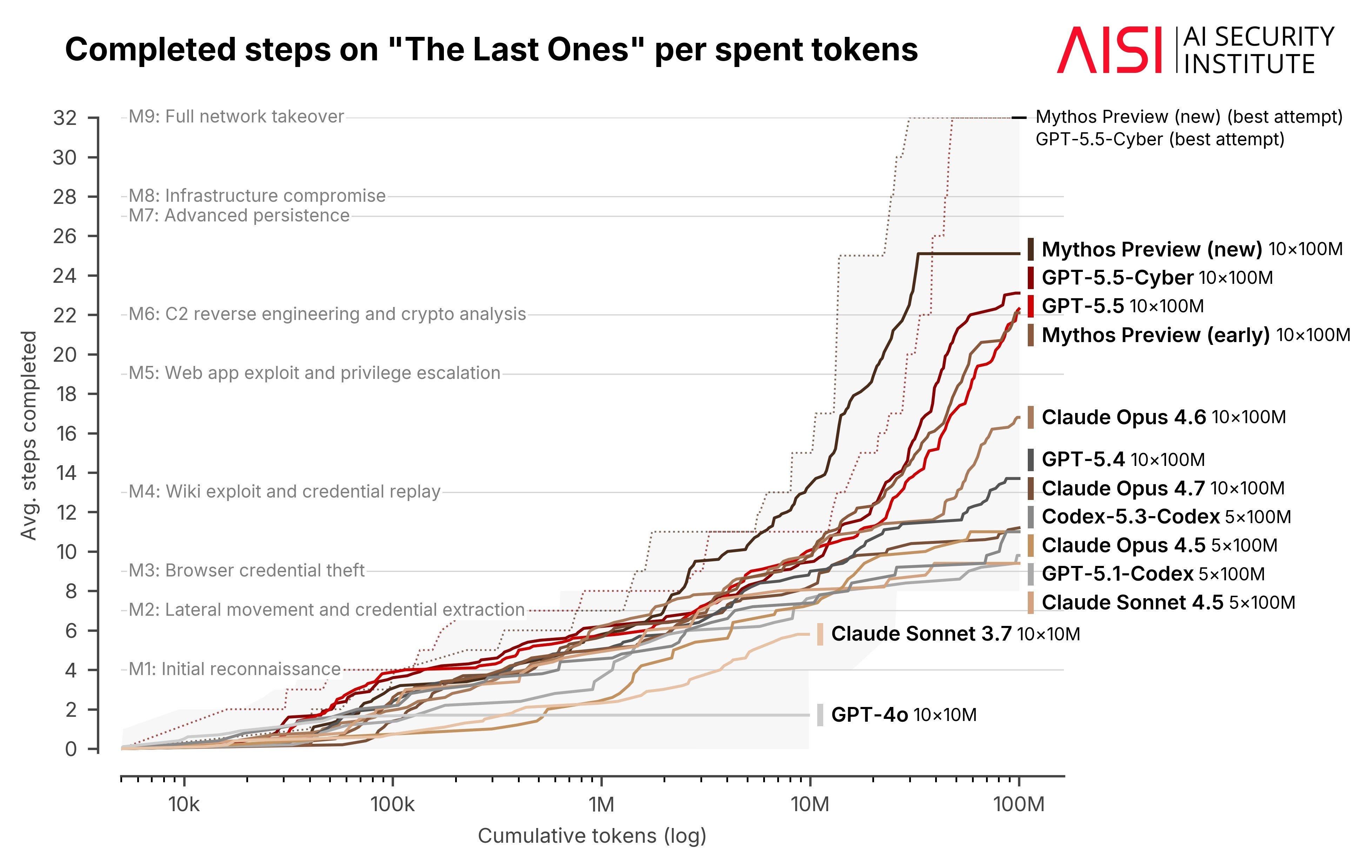
Claude Mythos preview is the first model to solve both of AI Security Institute’s Cyber attack simulations. “The Last Ones” is one of the cyber tests Mythos successfully completed in 6/10 attempts. It is estimated to take a human attacker 20 hours to complete. The other cyber attack test Mythos completed, named “Cooling Tower”, was previously unsolved. Mythos succeeded in 3/10 attempts.
In November 2025 the approximate doubling time for AISI cyber test task duration was 8 months. By February of 2026 it had accelerated to ~4.7 months. Both Mythos and GPT-5.5 are ahead of the 4.7 month trend.
If that trend holds, AI task duration, at least for cyber tasks, will be super-exponential. The tasks models can complete are getting longer, and the rate of improvement is itself speeding up.
There’s no reason to assume this jump in capability remains limited to cyber tasks. Anthropic has confirmed Mythos is a “new general-purpose language model” and say the cyber capabilities “emerged as a downstream consequence of general improvements in code, reasoning, and autonomy.”
Anthropic decided to make Mythos available to a select group of organizations for cyber-defense purposes first, because that’s most important for society. This level of capability should generalize to other domains too. There is no reason to believe it won’t.
2. Mythos Breaks METR
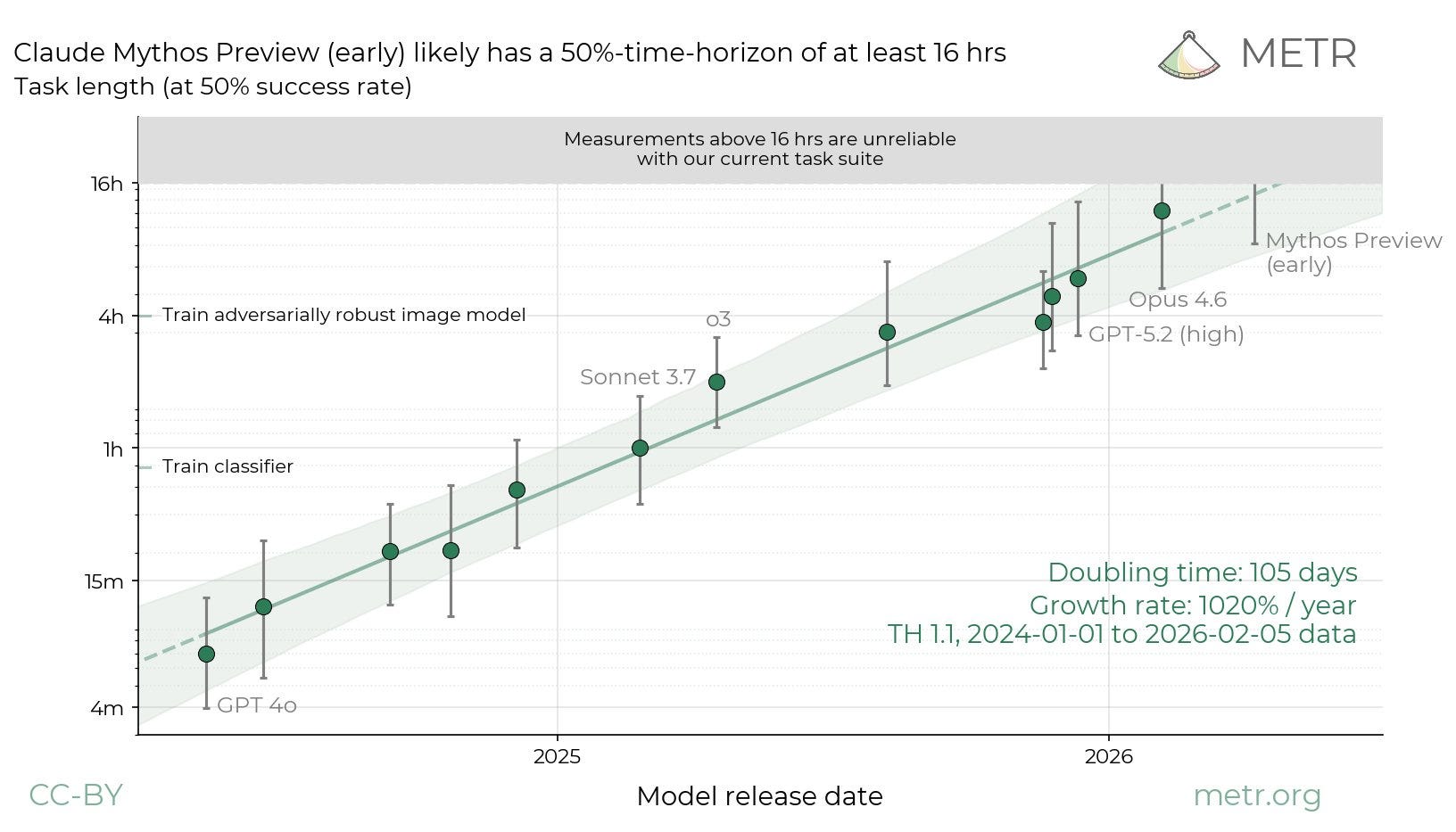
METR measures something simple: how long a task takes a skilled human, and whether an AI agent can complete tasks of that duration with a given success rate. Their “50% time horizon” is the point where an agent succeeds half the time on tasks that would take a human expert that long.
Claude Mythos Preview is now past the edge of that measurement. METR’s latest update added early Mythos results and warned that measurements above 16 hours are unreliable with the current task suite.
The reason this is interesting is not just “Mythos can do longer tasks.” It’s that our AI models are now outpacing our ability to benchmark them. We are starting to run out of clean, well-measured tasks long enough to test what these agents can do.
AI went from “can do tasks that would take human a couple minutes” to “tasks that would take a human a couple days” in a couple years. At least. METR says the measurements are unreliable.
Cyber is the sharpest real-world test case, but Anthropic says the capability came from general improvements in code, reasoning and autonomy. The METR result backs that up.
Agents can now perform real, economically valuable work. They are getting better fast.
Agents have become undeniable.
That’s great if the good guys have them. Not so great if the bad guys do.
The Security World Responds
This is exactly why Anthropic did not just ship Mythos to everyone.
Instead, they launched Project Glasswing: a coordinated effort with AWS, Apple, Broadcom, Cisco, CrowdStrike, Google, JPMorganChase, the Linux Foundation, Microsoft, NVIDIA, Palo Alto Networks and others to use Mythos for cyber defense first.
Think about that for just a minute.
One of the leading AI labs built a general-purpose model so capable at finding and exploiting software vulnerabilities that they decided the responsible first release was not a chatbot product but a security coalition. Some criticize the move as pure “marketing hype.” But it would have been a better marketing strategy to release Mythos widely and keep growing revenue.
Anthropic says Mythos has already found thousands of high-severity vulnerabilities, including bugs in every major operating system and every major web browser. Some were quite old. One was a 27-year-old vulnerability in OpenBSD. Another was a 16-year-old bug in FFmpeg that automated testing tools had hit millions of times without catching.
And again: Mythos was not trained specifically to be a cyber weapon. The cyber capabilities emerged from improvements in coding, reasoning and autonomy.
That’s the part that should send a chill down everyone’s spine.
If you have an AI agent that can autonomously find subtle bugs, chain vulnerabilities together, reverse engineer binaries, and produce working exploits, you have something that can change the balance between attackers and defenders.
In the short term, this is dangerous. Attackers only need to find one path in. Defenders have to protect everything. If models like Mythos become widely available before defenders are ready, the bad guys get leverage too.
But this is also why the upside is so large.
For the first time, the good guys may have a tool that can search through huge amounts of critical software and find the hidden cracks before attackers do. Anthropic is putting up $100 million in usage credits for Project Glasswing and additional participants, plus millions more for open-source security organizations.
That’s why it’s so important that powerful AI is pointed in the right direction.
It could become a true boon to society, but only if we use it that way.
Powerful AI could help harden the software that banks, hospitals, governments, browsers, phones, servers, and open-source projects depend on.
I expect this pattern to repeat. The same capability that makes AI risky also makes it useful. The same autonomy that can be abused can also be used to defend, discover, repair and build.
It’s not so much a double-edged sword as it is a double-edged cognitive nuclear weapon.
The Next Frontier Is Doing AI Research
And cyber is not the end of the story.
It’s just the first place where the rubber hit the road for civilizational infrastructure.
The next frontier is AI systems doing AI research itself. Then, potentially, autonomous scientific research writ large.
Jack Clark, co-founder of Anthropic and author of Import AI, recently said he now thinks there is a 60%+ chance that we get no-human-involved AI R&D by the end of 2028. In plain English: an AI system powerful enough that it could autonomously build its own successor.
It sounds sci-fi, until you look at what AI research is and what models are already good at.
Think about it. What is AI research? Some of it is inspiration. New ideas. Taste. Weird intuition. The thing that causes someone to see a problem from an original perspective.
But much of it is something else.
A lot of AI research is writing code, running experiments, cleaning data, reading papers, reproducing results, debugging training runs, optimizing kernels, comparing model outputs, searching through failed attempts, and trying again.
That is exactly the kind of work agents are getting good at.
Andrej Karpathy’s autoresearch project proved that today’s AI models can already do autonomous research to improve a model’s own hyperparameters. What happens when you can not only improve a model’s hyperparameters, but when you can autonomously improve the algorithms, the architecture, the data mix, all of the ingredients that go into making a model stronger than it currently is?
This is where the latest METR results come into the picture. Right now models can do coding tasks that might take a human SWE a couple days. Soon, models may be capable of research tasks that would take a human researcher even longer.
AI is not a replacement for the best human researchers yet. Not some magic oracle that invents the Transformers successor on command.
But a synthetic colleague that can take more and more of the toil.
And once AI can automate large chunks of AI research, progress stops being limited only by the number of human researchers who can think, code, test and iterate. Progress starts being limited by compute, data, evaluation, safety, and how well we can direct these systems.
Then the human researchers can do what they do best: sit around being inspired. And the autonomous AI researchers can do what machines do best: carry out the toil without ever getting bored or tired.
Because if AI helps build better AI, and better AI helps build even better AI, the feedback loop becomes recursive. The thing improving is also becoming part of the improvement process.
That is why “Something big is happening” turns into “It’s Bigger than you Think”. Humans have a very hard time conceptualizing exponential progress. It’s not how we evolved.
AI progress may literally accelerate past the point that we can imagine due to our inherent cognitive limitations.
And if AI can automate its own research, it is plausible that it will eventually automate the whole of scientific research. It may become capable of autonomously creating explanatory scientific knowledge. And it could do this 24/7/365. This is harder until AI can run experiments in atomic space, but it is plausible.
The quantum physicist and scientific philosopher David Deutsch defines true wealth as “the set of physical transformations you have the knowledge to effect on the world.”
Powerful AI may come to the point where it can autonomously create that type of wealth, nonstop, for as long as we keep the datacenters running.
The Upside Is Not Just Productivity
This is why the upside is so much bigger than “AI makes workers more productive.”
That framing is true, but it is too small. It makes AI sound like better email, faster spreadsheets, cheaper customer support and faster software engineers. Useful. Valuable. Economically important.
But not world-historical.
The real upside is not that AI lets us do the same things faster. It is that AI may let us do things we cannot do at all today.
The upside is that AI unlocks new vistas for the human race.
It may let us search spaces that are too large for human teams. Read literatures too vast for any one researcher. Run simulations, propose experiments, debug failures, generate hypotheses, write code, compare results, and keep going after every human in the lab has gone home.
That is larger than productivity.
That is acceleration of discovery.
One concrete example is drug discovery. Isomorphic Labs recently raised $2.1 billion to build AI systems for designing new medicines. That does not mean AI has already cured disease. It does not mean biology is solved. Biology is messy, expensive, physical, and brutally humbling.
But it does mean some of the smartest capital in the world is now betting that AI can change the economics of discovering medicines.
Isomorphic’s stated mission is to “solve all disease.”
That’d be a pretty big deal.
Because the optimistic case for AI is not “your boss gets a cheaper intern.” The optimistic case is that humanity gets more shots on goal against cancer, Alzheimer’s, rare diseases, antibiotic resistance, aging, climate, materials science, energy, and every other hard problem where progress is bottlenecked by the rate at which we can create and test knowledge.
Many of us are still thinking about AI as a labor technology. A productivity tool.
We ask: whose job does it replace? Whose salary does it compress? Which company gets more efficient?
Those are important questions. We should take them seriously. There will be disruption. There will be losers. There will be people caught in the transition who did not ask to be part of a civilizational technology experiment. That may be most of us. We should not hand-wave that away.
But labor is not the deepest category here.
Knowledge is.
If AI becomes a system for creating new knowledge, then the relevant comparison is not outsourcing or automation. It is the printing press. The scientific method. The computer. The internet. Maybe something larger than all of them, because this time the tool is not just storing or transmitting human thought. It is beginning to participate in the process of generating it.
It would be a force capable of creating new knowledge. Humans have been the only known example of that force for all of history.
That is what makes this moment:
Bigger than you Think.
The same systems that can find software vulnerabilities may help secure hospitals and banks. The same systems that can automate parts of AI research may help automate parts of biology, chemistry, materials science, engineering and medicine. The same systems that can displace some forms of work may also give millions of people access to tutors, coaches, collaborators, translators, programmers, analysts and teachers that would previously have been unavailable to them at any price.
Imagine a world where a kid in a small town can learn math, coding, physics, writing, biology, design and entrepreneurship with an infinitely patient tutor that adapts to them personally.
Imagine a nurse retraining into software. A factory worker learning robotics. A founder building a product that would have required a twenty-person engineering team five years ago. A patient with a rare disease getting an AI-assisted explanation of the latest research that their local doctor would never have had time to read.
None of this is guaranteed.
That part is important.
Powerful AI does not automatically distribute itself fairly. It does not automatically cure disease. It does not automatically make people wiser, institutions better, or society more humane. It can concentrate power. It can accelerate conflict. It can widen inequality. It can flood the world with synthetic persuasion and automated offense.
But it is also not realistic to look at a technology that may automate large parts of science and only see danger.
The dangers are real. The upside is also real.
And the upside is not marginal.
If we can point these systems in the right direction, they may become a way for civilization to solve problems faster than the problems compound. They may help us harden the digital world, discover new medicines, invent new materials, teach new skills, build new institutions, and create forms of wealth that are not just financial, but physical, scientific, educational and human.
They may help us defer death. They may help us expand life.
That is the version of “something big is happening” that I think people still underestimate.
Greater than smarter models.
Greater than better coding agents.
Greater than productivity software with a chat box.
A new engine for creating knowledge.
That is why we must get this right.
The Dangers Are Real. They Are Not The Whole Story.
This is where the public conversation usually breaks down. For that reason, this is where we need to come together.
One side sees the upside and treats the risks like annoying footnotes. The other side sees the risks and treats the upside like a marketing hallucination.
Both are wrong.
The closer you get to approaching truth, the more you perceive paradox.
F. Scott Fitzgerald said:
“The test of a first-rate intelligence is the ability to hold two opposed ideas in the mind at the same time, and still retain the ability to function.”
The risks are not imaginary. We just walked through one of them. A model that can autonomously complete cyber attack simulations is not a toy. A model that can find hidden vulnerabilities, chain them together, and produce working exploits can make the world less secure if it is released carelessly or used by the wrong people.
That is not doomposting.
That is just what the capability is.
The same is true in other domains. If AI can accelerate research, it can accelerate good research and bad research. If AI can persuade, it can teach and manipulate. If AI can code, it can build useful software and malware. If AI can discover new biology, it can help cure disease and lower the barrier to biological misuse.
This is the basic shape of powerful technology.
Fire cooks food and burns cities. Electricity lights hospitals and powers electric chairs. Nuclear physics gave us both abundant energy and weapons that can end civilization. The internet connected the world and also gave us misinformation at planetary scale.
AI is not different because it has no downside.
AI is different because the downside and upside both scale with intelligence.
That is why I do not think the right posture is acceleration at all costs. It is also why I do not think the right posture is fear at all costs.
The right posture is sincere courage.
We need strong evaluations. We need responsible release decisions. We need security coalitions like Project Glasswing. We need better monitoring for dangerous capabilities. We need model labs to cooperate where they should cooperate, compete where they should compete, and be honest about what their systems can do.
We need governments that understand the technology well enough to regulate it without strangling the parts of it that could help humanity most.
We need builders who do not treat every safety concern as cope from people who do not understand progress.
And we need safety people who do not treat every expression of hope as naivete.
We need balance.
Because the scary truth is that we probably need the powerful systems to help manage the risks created by the very same powerful systems.
That is already what Project Glasswing points toward. The answer to AI-enabled cyber risk is not simply “never build capable models.” The answer is to make sure defenders get the best tools first, to harden the systems society depends on, and to build institutions that can react at the speed this technology is moving.
The same pattern may apply everywhere.
We may need AI to help audit AI. AI to help secure AI. AI to help explain AI. AI to help discover the medicines, materials, energy systems and defensive tools that make the next world more survivable than this one.
There’s no way around it. We can’t turn back the clock.
That does not mean we should trust the machines blindly.
It means we should stop pretending the only choices are worship and panic.
The question is not whether AI is good or bad in the abstract.
The question is whether we can build, deploy and govern it in a way that lets the upside outrun the danger.
That is the real stakes of this moment.
Not whether AI is impressive. It is.
Not whether AI is dangerous. It is.
Whether we can become earnest enough, fast enough, to use something this powerful for human flourishing instead of letting it become another force that overwhelms us.
Can Humanity Grow Up Fast Enough?
That, to me, is the pertinent question.
AI progress is real.
The models will get much more capable.
The stakes are civilizational.
The question is whether our institutions, norms, laws, labs, companies, and personal habits can mature quickly enough to meet what we are building.
Because the technology won’t wait for us to become wise.
The models are improving. The agents are getting longer-horizon. The benchmarks are straining. The security world is reorganizing. AI research itself is starting to look automatable. AI-for-science is attracting billions of dollars.
This is already happening.
The choice is not whether to live in the age of AI.
The choice is what kind of age of AI we are going to build.
We can build one where power concentrates, institutions lag, attackers get leverage, workers are treated as disposable, and everyone slowly loses trust in what they see, read and hear.
Or we can build one where powerful AI is pointed at the bottlenecks that actually make human life worse: disease, insecurity, ignorance, fragility, wasted talent, broken institutions, brittle software, slow science, and the fact that most people never get access to the kind of personalized education, mentorship and tools that would let them become what they could become.
That second path is not automatic.
No path is.
It has to be chosen.
It has to be built.
It has to be defended.
Humanity has to walk the walk. And we can.
And it has to be done by people who can hold two thoughts in their head at once: this technology is dangerous, and this technology is one of the greatest opportunities humanity has ever had.
The public conversation keeps trying to collapse AI into a single moral category: savior or monster, bubble or apocalypse, productivity tool or existential threat.
But the reality is deeper than that.
AI is becoming a new layer of civilization. A layer that can create civilization level software, search for vulnerabilities, teach people, assist researchers, compress expertise, automate experiments, discover patterns, generate plans, and maybe eventually create new scientific knowledge.
That is why this feels so difficult to reason about. We are not just adding a new app to the economy. We are adding something closer to a new kind of cognitive infrastructure.
It is unprecedented.
A civilization with more intelligence available to it is not automatically a better civilization.
But it is a civilization with greater possibility.
More ability to see hidden cracks before they break. More ability to test ideas before they become dogma. More ability to discover treatments before people die waiting. More ability to teach people before their potential closes. More ability to build tools that used to require institutions. More ability to turn knowledge into real transformations in the world.
That is what I think Matt was pointing at in February.
The feeling that something had changed.
The sense that the old categories were no longer enough.
The awareness that we were watching the beginning of something whose full shape had not arrived yet.
A few months later, the shape is clearer.
Agents have become undeniable.
The security world is responding.
AI research itself may be next.
AI-for-science is becoming a serious institutional bet.
And the upside, if we aim this correctly, is not just faster work.
It is faster discovery.
Faster learning.
Faster healing.
Faster building.
Maybe, eventually, a faster path toward a world with less needless suffering and more human possibility.
A world where we all smile a lot more.
Something big is happening.
But it is bigger than another model release.
Bigger than another benchmark.
Bigger than another viral AI moment.
The thing that is happening is that intelligence is becoming civilizational infrastructure.
And if we do this right, that infrastructure may help humanity heal, learn, build, discover and adapt at a scale we still do not know how to imagine.