

Happy Sunday everyone!
To those of you in the U.S., I hope you’re enjoying the long Memorial Day weekend.
It’s rainy and cloudy where I live In Georgia. I grew up on the Jersey Shore, and when we’d have a rainy Memorial Day weekend, it was always a huge bummer.
I’m adding to the Attention Heads roster of posts this week. Here is the first edition of “Paying Attention”. A weekly newsletter of the top 3 things I paid attention to from the previous week.
Hope you enjoy it, and if you do, please share it with your friends.
1. AI breaks ground in Math
What happened
OpenAI reported that an internal, general-purpose reasoning model, solved an 80 year-old math problem called the “Unit Distance” problem. It was a favorite problem of mathematician Paul Erdős. AI had assisted in solving Erdős problems recently, but this was the first time the AI could be attributed with making the main contribution. Erik Hoel wrote an interesting article for The Intrinsic Perspective arguing that previous models may have also been capable of solving this problem. I wrote a longer article that goes into the details.
Why it held my attention
This is an undeniable contribution by an AI system to objective scientific knowledge. It is unprecedented. Truly a world-historical first moment. Human beings have been the only entity capable of creating explanatory scientific knowledge, until now.
What I’m carrying forward
AI contributes to Math first because Math is the perfect domain to train AI on. It is abstract and the solutions produced can be verified as correct. This is only the beginning. No doubt that this type of knowledge creation is on the way for other fields. It will be theoretical fields next but eventually empirical fields once robotics comes online. The main blocker is the ability to run experiments in atomic space.
2. Codex Workflows
What happened
Jason Liu does Developer Experience at OpenAI and posted a blog “Codex-maxxing”. It has at least 10 worthwhile Codex workflows. I posted a few of the workflows I implemented over on X and they were received well.
Install relevant skills using persistent memory

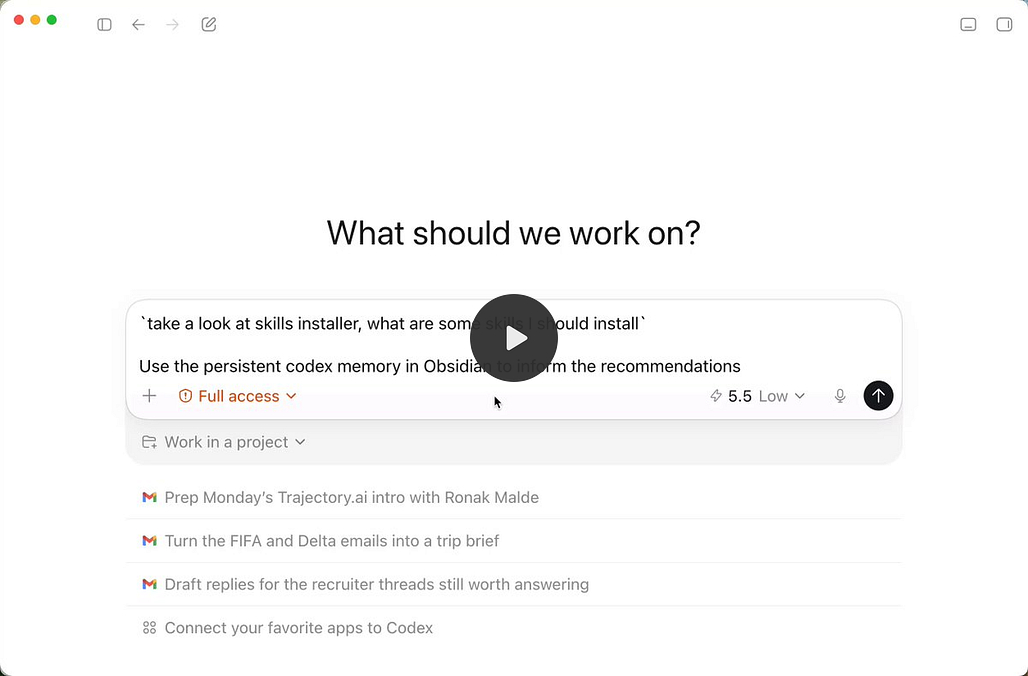

How to setup persistent memory with Obsidian


Why it held my attention
Codex is improving rapidly. I’ve switched to it almost exclusively for my personal project. I still use Claude Code/Cowork at work because my company pays for it. Codex with the ChatGPT Pro sub is a great deal at $200/month. I never worry about getting rate limited. Codex is so customizable and the Mac app is a delight to use. I have been thinking recently about the Codex Mac app as the platform of the AI age.
What I’m carrying forward
I believe you’ll start to see “Codex native” applications and businesses started. Where the app/workflow is designed to work natively within the Codex Mac app itself. I am working on a project around this right now called HyperAgent.
3. Gemini 3.5 Flash
What happened
Google DeepMind released Gemini 3.5 Flash, it’s new flagship AI model. It performs well on several benchmarks, which is typical for Google models. More of interest is the fact that it performed well on benchmarks that test real-world agentic capability. Historically Google models have over-performed on benchmarks and under-performed on real-world capability.


Why it held my attention
Google is clearly second-class when it comes to LLMs, behind Anthropic and OpenAI. It’s surprising because they are resource, cash and research bench rich. This release looks like a step in the right direction of agentic capability. Full disclosure: I haven’t used the model yet. Another issue Google has is that it’s unclear the best way to use their models for agentic capability.
What I’m carrying forward
This is the smaller Flash version of the 3.5 generation of Gemini models. It will be interesting to see how the Pro version of Gemini 3.5 performs. It needs to outpace both GPT-5.5 and Claude Mythos for me to consider Google back in the LLM game.
Gemini 3.5 Flash wasn’t the only thing Google released last week. They also released Gemini Omni, a new multi-modal model that starts with video. This is potentially the more interesting release. I still need to experiment with it.