

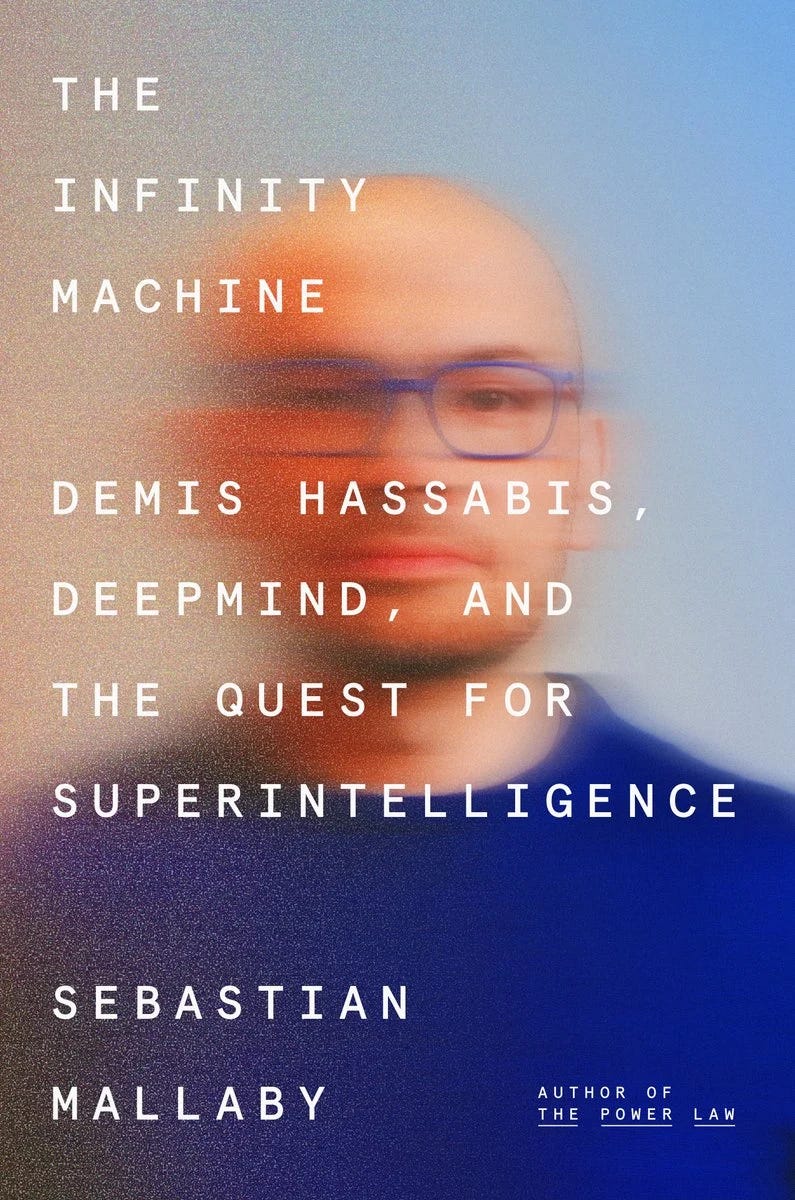
I picked up (as an audiobook) “The Infinity Machine” by Sebastian Mallaby expecting a straightforward biography about Demis Hassabis. What I got instead was a portrait of a particular kind of ambition: not the desire to dominate a market, but the desire to understand intelligence itself, build it, and turn it back toward the mysteries of nature.
My brief review: this is worth reading if you want to understand DeepMind not just as an AI lab, but as the expression of one person’s unusually coherent theory of intelligence, games, science, and progress. The book weaves a thread from Demis’ childhood to DeepMind today. The constant is his desire to unlock the mysteries of life with technology.
One detail from the book that crystallized this for me was the AlphaFold breakthrough. Demis was quoted as saying that science is the one field where AI can be completely positive. It’s obvious that Demis is interested in unlocking the mysteries of life.
What stuck with me
I got the impression that Demis is not in the race for power, money, or fame. None of the usual big tech trophies seem to be the point. He wants to build AI because he believes it is the most important thing to build for humanity. To the extent he uses power or influence, it seems to be as an instrument for a more transcendent aim.
The other AI lab leaders all say they want to benefit humanity. With Demis, I actually believe it’s more than talk.
Demis is a true believer in the idea that Turing machines can take us all the way to AGI. That we don’t need anything more than the very classical machine that Turing invented in 1936.
It’s a testament to his character that many of the colleagues who are by his side today, have remained by his side since the college days.
The tension
The central tension I felt is that DeepMind understands the gravity of its place in the world, but it still sits inside one of the most powerful commercial institutions on earth. The scientific ambition is to build safe AGI and use it to accelerate discovery. The corporate reality is Google: scale, competition, product pressure, and shareholders.
That is the drama the book left me sitting with: can a lab with genuinely scientific and humanitarian aims stay oriented toward those aims when it is embedded inside one of the most successful businesses of all time? This is what Elon and Sam Altman claim they were worried about when they started OpenAI.
And yet, I did not get the sense that Demis regretted joining Google. The resources mattered. The distribution mattered. The bargain may have been necessary. But it is still a bargain, and the consequences of that bargain become larger as the systems become more powerful.
Who should read it
I’d recommend it to anyone trying to understand the AI race beyond product launches, benchmark charts, and company drama. It is especially useful for builders who want to study long-term taste, institutional patience, and obsession with first principles. I would also recommend it to skeptics who assume every AI leader is motivated by money or power. The book does not remove every concern, but it makes Demis’ ambition legible.
Closing
By the end, I understood why Demis and DeepMind can feel like they have the “mandate of heaven.” If someone is going to build toward AGI, you could do much worse than Demis Hassabis. But that is also the strange problem of this era. So much of the future may depend not only on capabilities, but on the character of the people and institutions building them. DeepMind may still be in as good a position as anyone to win the race. The world may be lucky if it does.