

Overview
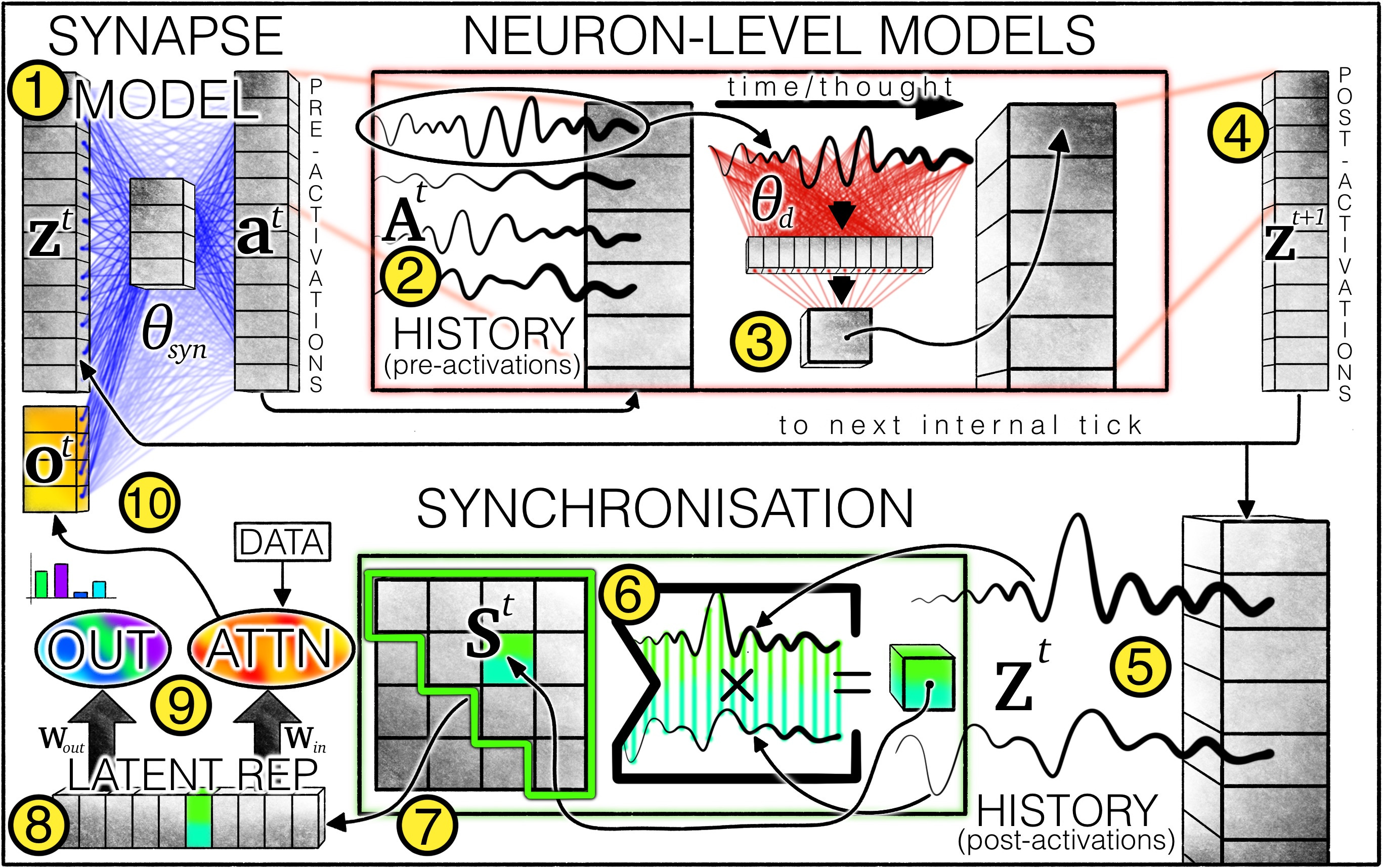
Sakana AI's latest innovation, Continuous Thought Machines (CTMs), introduces temporal dynamics at the neuron level, allowing neural networks to process information over time, similar to how your own brain works.
"For these reasons, we argue that time should be a central component of artificial intelligence in order for it to eventually achieve levels of competency that rival or surpass human brains."
The research team at Sakana AI believe that this can increase both the flexibility and generalizability of LLMs.
Key Innovations
Internal Recurrence: CTMs incorporate an internal timeline, enabling the model to process data through multiple internal "thought steps," independent of the input sequence.
Neuron-Level Models: Each neuron maintains a history of its activations and utilizes a private model to process this history, allowing for nuanced temporal dynamics.
Synchronization as Representation: CTMs measure the synchronization between neuron activations over time, using this as a core representation for decision-making.
"The temporal dynamics unlocked by recurrence — the precise timing and interplay of neural activity — are equally crucial. The CTM differs from existing approaches in three ways: (1) the decoupled internal dimension enables sequential thought on any conceivable data modality; (2) private neuron-level models enables the consideration of precise neural timing; and (3) neural synchronization used directly as a representation for solving tasks."
CTMs give digital neural nets what biological brains need to generate subjective experience: time.
The video shows a CTM solving a maze. Each iteration shows 75 distinct “time steps” where the CTM computes the synchronization representation to take action in the maze.
Biological Inspiration
Traditional neural networks abstract away the temporal firing patterns of neurons. CTMs, however, draw inspiration from biological neural dynamics, such as spike-timing-dependent plasticity, to achieve more natural and flexible intelligence.
The below graphic illustrates the activation pattern of an individual neuron over time.
Traditional neural nets don’t compute activations at this level of detail, making CTMs far more adaptable and flexible.
Implications
Enhanced Reasoning: By processing information over multiple internal steps, CTMs can potentially handle complex reasoning tasks more effectively.
Adaptive Computation: The model can adjust its internal processing depth based on task complexity, leading to efficient resource utilization.
Potential for Sentience: Incorporating temporal dynamics at the neuron level may be a step toward developing machines with more human-like cognition and subjective experience.
Continuous Thought Machines are a novel architecture for AI systems which show the potential to take us beyond the Transformers era.
References:
Interactive Report: https://pub.sakana.ai/ctm/
Full Paper: https://arxiv.org/abs/2505.05522
GitHub : https://github.com/SakanaAI/continuous-thought-machines/