

Psychology has this concept of crystallized vs. fluid intelligence. Crystallized intelligence is knowledge and memory gained from experience. The things you learned from a book and can write down in an exam. Fluid intelligence is the ability to think in the moment and solve problems independent of past learning.
Today’s AI systems are almost entirely crystallized intelligence.
When AI systems gain fluid intelligence, we’ll see the next step change in capability.
Continual Learning’s Promise
The concept of fluid intelligence in AI research is known as Continual Learning. An AI model currently goes through ~two learning phases:
Pre-training - this is like general education, where the model is fed massive amounts of internet and other sources of data. From this the model learns the patterns of language inherent in that data. Also known as “next-token” prediction.
Post-training - this is like “on-the-job” training, where AI researchers use reinforcement learning (RL) techniques to give the model specific skills. The most effective forms of RL today are in domains where there is a verifiably correct answer. Examples are coding and mathematics; and it’s no surprise that those are dimensions AI has made the most progress on.
One could argue that there is some element of continual learning in today’s AI models. People talk about in-context learning, which is an established capability. In-context learning is where a model learns new information within the space of its context window. Most frontier models today have context windows of 1 million tokens and reportedly have parameter counts on the order of single digit trillions, though the exact parameter count is not shared publicly by the AI labs. Even given a 1 million token context window, it’s been shown that performance begins to degrade after ~250k tokens.
A person using an AI model has influence over a scratchpad of ~250k tokens; while trillions of frozen weights stay untouched.
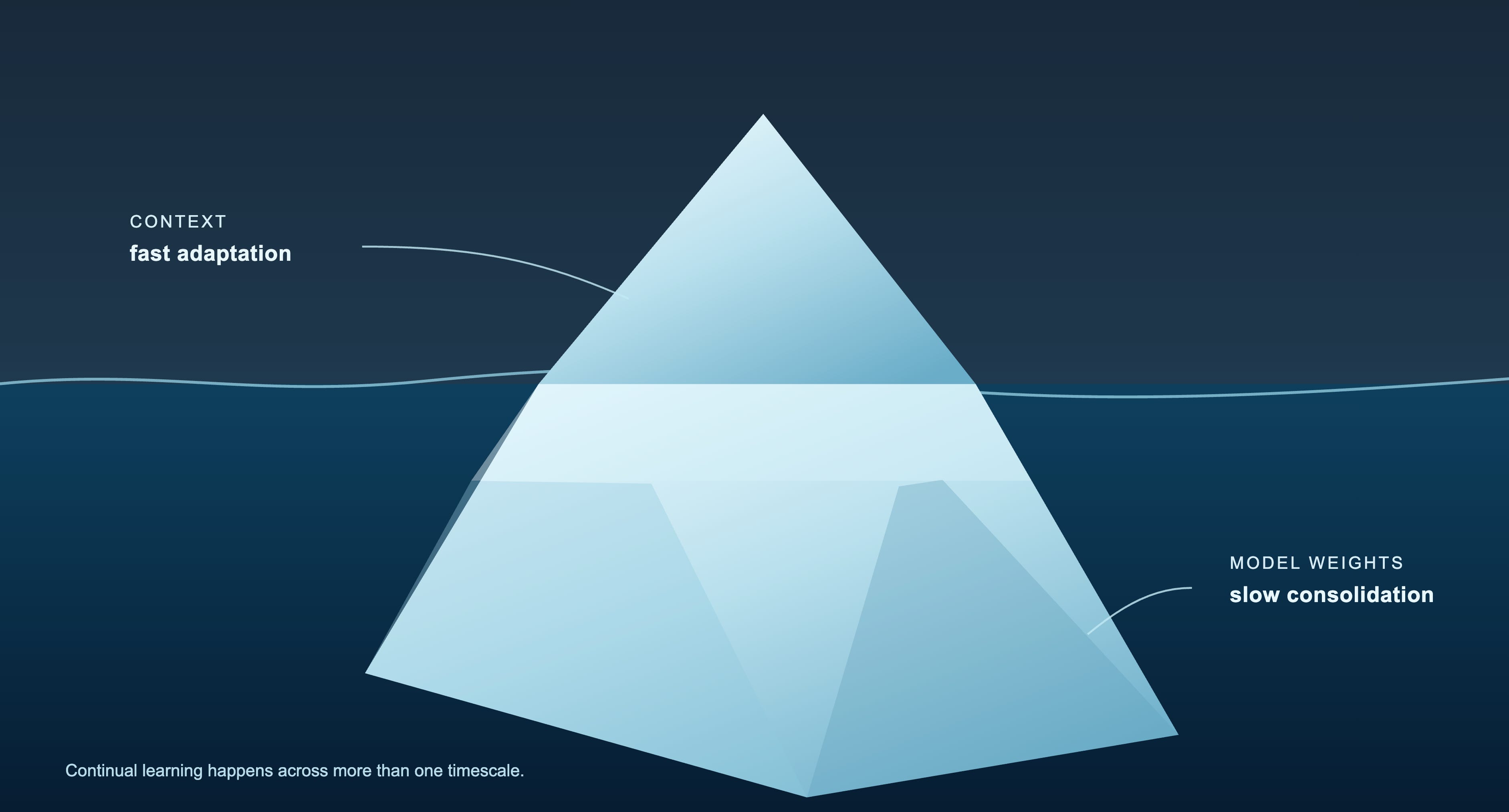
Think about today’s AI models like an iceberg. The vast majority of the knowledge they contain is frozen beneath the surface of the water. You have influence over a tiny fraction of their knowledge at the very tip of the iceberg.
Continual learning is when your interactions with the model affect the whole iceberg.
In a way that doesn’t cause the model to forget what it already knows a.k.a “catastrophic forgetting”.
The reason continual learning is the holy grail of AI research is because the implications are immense.
The Neo-Labs Pursuing Continual Learning
Several prominent AI researchers who left frontier AI labs like OpenAI and Google DeepMind are expressly pursuing continual learning.
“A human being lacks a huge amount of knowledge. Instead, we rely on continual learning.” - Ilya Sutskever on The Dwarkesh Podcast
SSI has not confirmed a model release, though there are rumors. If it releases a model capable of continual learning, everyone will be looking to see what type of CL: a system that continuously updates its model weights without forgetting what it knows, or a thinner feedback layer that may still be useful but leaves the underlying model mostly unchanged. The difference is whether SSI has solved the barriers to continual learning that I will return to at the end of this essay.
SSI describes itself as a straight-shot lab, built around one goal: safe superintelligence. Taken literally, it means they aim for their first release to be a safe, superintelligent AI model.
Jerry Tworek, who leads up Core Automation, spent seven years helping build OpenAI’s reasoning stack. His departure from OpenAI does not prove he has abandoned scaling, but it is suggestive: he may believe bigger transformer models, trained once and deployed statically, may not be enough to reach AGI. Core Automation is his wager on what has to come after that recipe. It’s also possible he just wanted a change and to try something new.
“Core Automation is a lab created to build models that continuously learn and learn from deployment.”
Tworek’s point in the Sequoia conversation is that today’s options are inadequate: in-context learning is too limited, while repeated fine-tuning causes the catastrophic forgetting mentioned. The goal is to bring learning into use at inference time and to dissolve the gap between test time and training time, so that every test is also a train.
Ronak Malde’s Trajectory is taking a more practical approach: it uses real-world traces, corrections, retries, and edits to improve and redeploy models. Trajectory is pursuing something more like continuous improvement: a feedback loop tailored to a specific organizational problem, rather than a general-purpose model that learns continuously at inference time.
How It Might Work: Learning at Multiple Timescales
The most interesting research on continual learning is dissolving the clean line we’ve drawn between training and inference. Today, a model is trained once, its weights are frozen, and then it encounters the world through a context window. New information comes in, but only at the tip of the iceberg. The context changes while the underlying model does not.
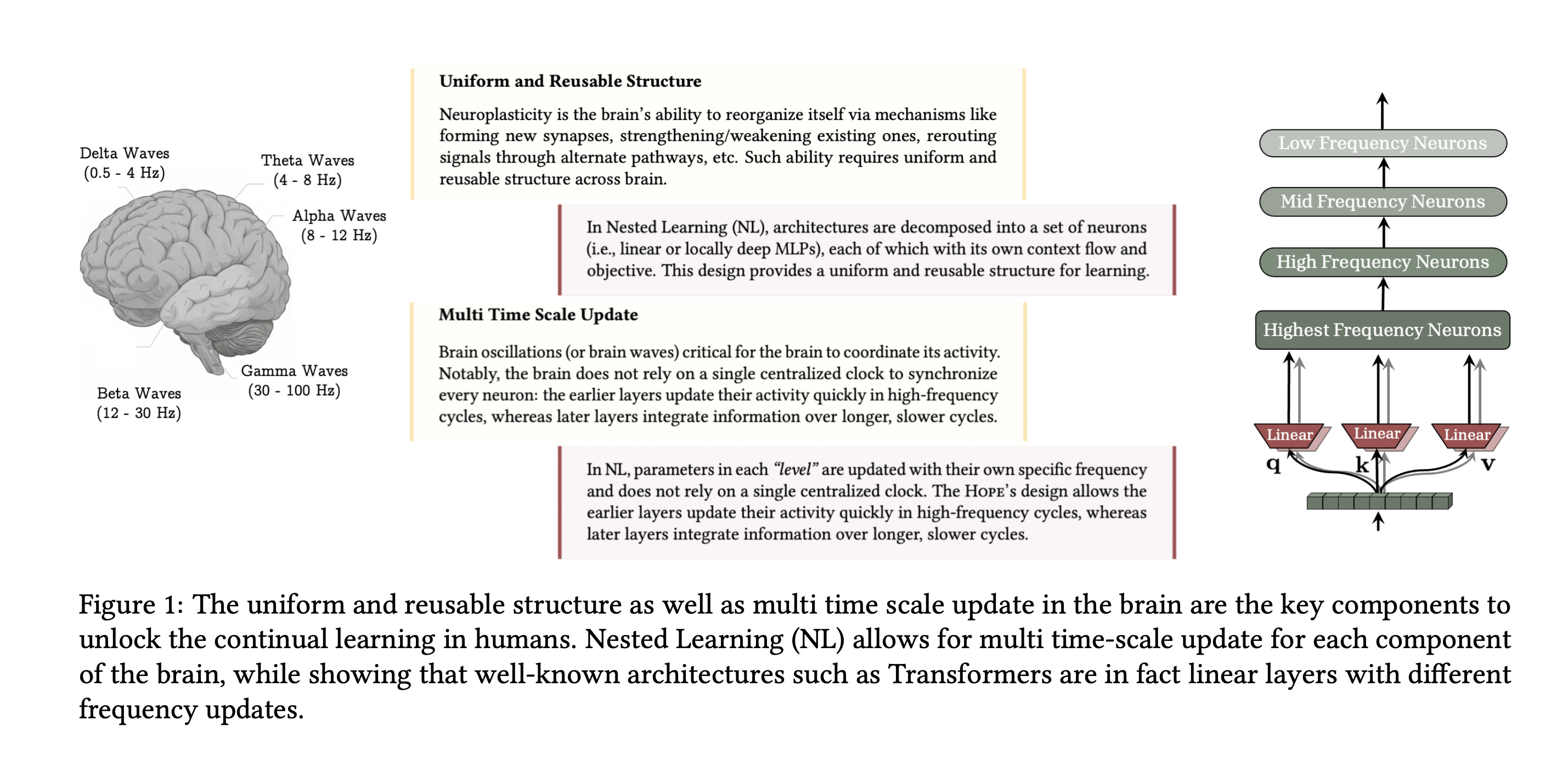
Nested Learning and Learning, Fast and Slow both point toward a different picture. They treat learning as a spectrum of updates happening at different speeds. Some adaptation can happen quickly, in the context of the immediate task. Other lessons can be consolidated slowly, into the model’s deeper weights. From that perspective, inference is no longer simply the period after learning has ended. It becomes part of the learning process itself.
Google’s Nested Learning paper makes this explicit. It treats a model not as one fixed object, but as a network of nested optimization problems, each with its own memory and update frequency. The paper’s “continuum memory system” replaces the familiar short-term/long-term split with many layers of memory that update at different speeds. Its HOPE architecture is a proof of concept for that idea: some learning loops can react to the immediate context, while others preserve and consolidate what they learn over longer periods.
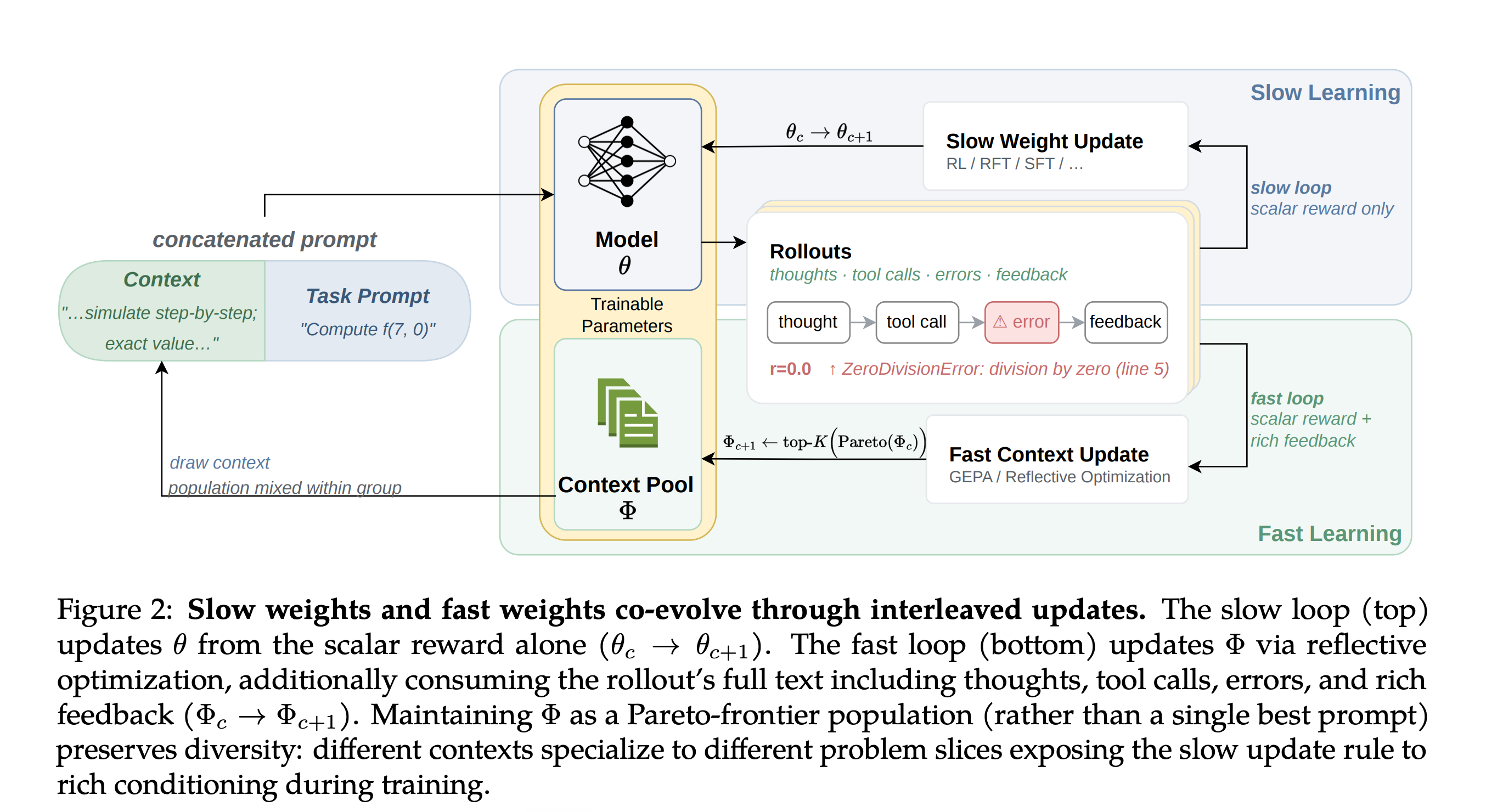
Learning, Fast and Slow arrives at a similar distinction from a different direction. Its Fast-Slow Training approach treats the optimized context as “fast weights” and the model’s parameters as “slow weights.” The fast weights are not literal parameter updates at inference time; rather they are an evolving “population” or set of prompts that can rapidly absorb task-specific feedback, while reinforcement learning makes slower updates to the model’s actual weights. The point is: don’t choose between a context window and a retraining run. Let fast adaptation and slow consolidation work together, so the system can keep learning without simply overwriting what it already knows.
There is a loose analogy here to Daniel Kahneman’s System 1 and System 2: one mode is fast, immediate, and responsive to the situation in front of it; the other is slower and more deliberative. The analogy is imperfect, but it gives us a way to see what these researchers are doing. They are trying to build learning systems with both a fast layer that can adapt in the moment and a slower layer that decides what should become part of the model itself.
The iceberg is a useful picture here. Fast learning happens at the tip, in the context of the immediate task; slow learning consolidates experience into the much larger mass below the waterline, in the model’s weights. The two timescales are not competing approaches. but rather one spectrum. They are complementary parts of the same learning system.
Five Implications of Continual Learning
Models with a genuine learning history - today’s models are like amnesiacs. They don’t carry state from session to session beyond writing down text in a markdown file. Dwarkesh Patel has a great analogy for this in his essay on the era of continual learning: “Imagine if the way students had to learn to play the saxophone is that one student tries to play it from a cold start, then after her first session, writes down a bunch of notes, then the next student waiting outside the music hall who’s also never played the saxophone reads all their notes before trying to play, and so on.” That’s what text file based memory is doing today. With real continual learning, models will absorb new skills into their model weights rather than trying to hack together markdown notes in their context.
Emergent skills over long-horizon tasks - imagine an AI model that can work continuously, without sleep, without a break, with infinite context. That same model, with continual learning enabled, could learn from every interaction, correcting itself as it makes progress. Now extrapolate that process out to years. Decades. Centuries. We simply don’t know what kind of capabilities might emerge from an immortal machine intelligence that can work eternally. (Or as long as the GPUs keep whirring).
Deep personalization — Deep personalization is where continual learning becomes intimate. A model that learns from every interaction with you would not just remember a prompt or a profile. It could build up a living context about your life: the experiences you have, the information you consume, the conversations you conduct, and the people you care about.
Over time, it could become a kind of reflection of your own experience, with a memory far more complete than any person’s. Instead of starting from scratch each time, it would meet you with the accumulated context of your life and update that understanding as your life changes.
For me, this is one of the most exciting opportunities in continual learning: AI that does not merely become more capable in the abstract, but becomes more useful in the texture of our real human lives.
Capability that compounds with human expertise — Continual learning could make expertise compound. Today, even when a brilliant person works closely with an AI system, most of what they teach it disappears when the session ends. A continually learning system could retain the judgment, corrections, and problem-solving habits it acquires from experts.
That creates a different relationship between people and AI. Nobel Prize winners working with a system on hard problems would learn from the system, but the system would also learn from them. As more people contribute their hard-earned knowledge, the system’s intelligence could compound over time. Not by replacing human expertise, but by absorbing and connecting it.
Fleet intelligence and collective learning — Deep personalization is a one-to-one relationship: one person, one deployed model, and a learning history built from their life together. Fleet intelligence expands that relationship outward. Every deployed instance could learn from all the people using it, then share what it has learned with the wider system.
That turns continual learning from a private advantage into a many-to-many network. Experience gathered in one corner of the globe can improve the system everywhere. If the system can reliably absorb, test, and distribute those lessons, learning would compound exponentially.
What Continual Learning Means for Society
Labor and expertise
If the five implications above turn out to be true, the question is not whether AI will replace human expertise. It is how human expertise transforms. A continually learning system may be able to absorb far more of the practical, mechanistic work we humans do: implementation, iteration, recall, and the accumulation of technical knowledge.
That could leave people with a more distinctly human role. Humans would still provide creativity, originality, judgment, and a sense of what is worth doing. We could become less like implementers executing a machine’s logic, and more like wise guides setting direction for systems that can carry it out.
At its best, that would relieve people of the need to act like machines. It would make more room for the parts of life that are most human: relationships, wisdom, personal growth, and the freedom to decide what kind of world we want to build rather than getting lost in the act of building.
Lock-in and switching costs
A model that has learned from you for three years is not interchangeable with a fresh one. Its value is not only in the model you can download or the profile you can export. It is in the accumulated context: the context it has built about your work, your preferences, your relationships, and the lessons it has learned through thousands, or even millions, of interactions.
That creates a new kind of switching cost. Moving to another AI system may mean leaving behind not just a tool, but a type of entity that knows you. It would be more like leaving a relationship. The upside is that the assistant becomes genuinely useful in a way a generic model cannot be. The downside is that the companies with the most users, data, and compute could see their advantage compound as their systems keep learning about you faster than everyone else.
This could be more extreme than the switching costs we see with cloud providers. With cloud infrastructure, a company may face the cost of moving data and rebuilding integrations. With continual learning, the thing left behind is an AI system’s accumulated understanding of the business itself: its decisions, edge cases, working habits, and hard-won context.
The same is true personally. Moving from a model that understands the details of your life to a fresh model that knows nothing about you may eventually feel less like switching software and more like starting over with someone new. That depth of lived context could become so valuable that, once it exists, switching no longer makes sense.
Concentration versus distribution of power
Lock-in does not only affect individual users and companies. It could reshape the distribution of power across the AI industry. The first lab to build a system that learns continually may gain an advantage that compounds with every new user and every new interaction.
That concentration would not necessarily require an explicit attempt to dominate the market. It could emerge from the mechanics of continual learning itself. If switching means abandoning years of accumulated context, then the system that gets there first becomes harder to leave and harder to compete with. The result could be a powerful gravitational pull toward the lab that first makes continual learning work at scale.
If that dynamic produces durable market power, governments and competition authorities may need to step in. Existing antitrust and anti-monopoly rules may need to be applied to a world in which a company’s advantage is not simply its software or data, but a learning relationship that customers cannot realistically take with them.
A Partition Between Public and Private Data
The promise of deep personalization comes with a tough data security question. A model can only become genuinely useful by learning from intimate details of a person’s life. But if it continually updates from those details, what prevents private information from leaking into the public data accessed by everyone else?
This will have to be solved. Continual learning systems will need hard boundaries between private memory and shared learning: strong access controls, data minimization, user consent, and designs that keep personal experience local or isolate it from the model’s broadly shared capabilities. Otherwise, the same mechanism that makes an AI feel like a trusted companion could turn it into a surveillance system that never forgets. This is a hard problem to solve.
What Remains Unsolved
Continual learning is the holy grail because it remains unsolved. The promise is enormous, but a system that changes from experience introduces problems that today’s largely frozen models avoid.
Forgetting: new learning can damage old capabilities.
Stability: a model must stay adaptable without becoming erratic or manipulable.
Evaluation: we do not yet know how to prove that a system has learned robustly over months or years, rather than merely improved on the last task.
Safety: if a model can learn from the world, it can also learn from bad data, adversarial inputs, and misaligned incentives.
The challenge is to help models learn, and un-learn, as they adapt and change with an evolving world.
Continual learning is the holy grail of AI not only because it would make models more powerful, but because it would change what they are: from static artifacts into intelligences with a history. Like the Grail of Arthurian legend, it is not a prize that can be seized by scaling what already works. Reaching it requires solving the hard problems of memory, safety, and judgment, and making sure that a system that can keep learning is worthy of what it is allowed to learn.
All four of the implications for continual learn are super powerful on their own. This fifth one, though, fleet intelligence, would take us into completely new territory:
“Fleet intelligence expands that relationship outward. Every deployed instance could learn from all the people using it, then share what it has learned with the wider system.”