

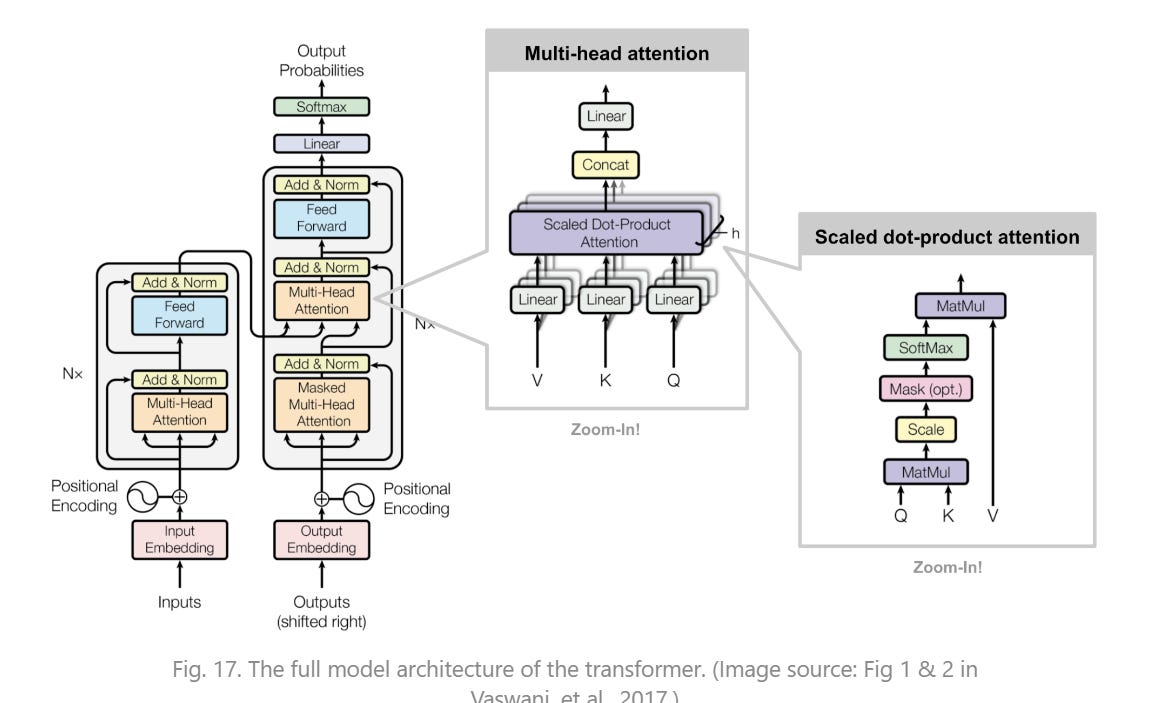
In 2017, a group of researchers published a machine translation paper with one of the great titles in the history of AI: Attention Is All You Need.
At the time, the title was technical. The paper introduced the Transformer, an architecture that dispensed with recurrence and convolution and made attention the core primitive for processing sequences. In retrospect, the title now feels mythical. It names the mechanism that helped unlock the modern AI era.
But the title also raises a deeper question.
If attention was the breakthrough needed to allow machines to become intelligent, what exactly is attention?
And if attention matters this much for machines, what does that imply about us human beings?
This is the question I want to use as the first real essay for Attention Heads, because it sits right at the center of what this publication is about. Artificial attention. Human attention. Consciousness. World models. Meditation. Technology. My life experience has shown me that attention is the most powerful force in the world..
My starting thesis is simple, and maybe too grand, but I think it is directionally true:
Attention is the most powerful force in the universe because it transforms potential into reality.
Not a physical force like gravity. Not a mystical substance. A causal force that acts on the informational substrate of reality. What receives attention gets selected, modeled, strengthened, practiced, funded, remembered, and eventually built.
Attention is where possibility becomes actuality..
What Machine Attention Does
The original Transformer paper is not about meditation, consciousness, or philosophy. It is about sequence transduction, especially machine translation. But the core idea is surprisingly approachable.
A model is given a sequence of tokens. To understand or produce the next representation, each token needs to know which other tokens matter. Some words depend on nearby words. Some depend on words much earlier in the sentence. Some phrases only make sense in relation to the whole.
Machine attention gives the model a way to ask:
Given where I am, what else in this context is relevant?
That is the breakthrough of Transformers and the attention mechanism at the fundamental level.
Instead of processing a sentence only step by step, self-attention lets tokens look across the sequence and assign weight to one another. Multi-head attention lets the model do this in several ways at once. One head might track syntax. Another might track reference. Another might track a phrase-level dependency. The model is not literally thinking in these terms, but the architecture creates room for multiple patterns of relevance to be discovered in parallel.
This is one reason the Transformer was so powerful. It made relation, not mere sequence, the center of computation.
A sentence is not understood word by word. It is understood through relations: this pronoun points back to that noun; this adjective modifies that object; this phrase changes the meaning of the whole. Attention lets a model dynamically weight those relations.
The results was a general purpose architecture for learning from context. Learning from the meaning between the words. This has changed the world.
Machine Attention Is Not Human Attention
It is important not to overstate the analogy.
Transformer attention is not awareness. It is not mindfulness. It is not subjective experience. It is a mathematical operation inside a machine learning model. It routes information by computing patterns of relevance among tokens.
A model attending to a word is not the same as a human attending to a breath, a face, a memory, or a feeling. As far as we know, Claude doesn’t actually care about the sentences it’s processing.
But the analogy is still revelatory.
The architecture that unlocked modern AI did not simply get bigger. It got better at selective relevance. It learned which parts of the context should influence what happens next.
That phrase, selective relevance, is the bridge.
Because human beings do not experience reality as a raw, complete, neutral feed either. We experience a world that has already been selected, filtered, weighted, interpreted, and stabilized by attention.
Most of the time, we do not directly experience the world. We experience generated perceptions overlaid onto reality. We live inside our mentally constructed world model.
And that world model is mediated by attention.
Human Attention Generates A World
Look around the room you are in right now.
Before reading this sentence, you were probably not conscious of the feeling of your feet, the exact shape of the shadows, the sound floor of the room, the temperature on your skin, the peripheral objects outside the center of your visual field, or the emotional tone in your body.
Those things were there. But they were not equally real to you.
When I suggest giving your attention to them, they become more real.
Attention is what makes some part of the field come forward.
This is one of the strange truths of ordinary experience: salience feels like reality. What captures attention feels more real, more urgent, more meaningful, more central. What falls outside attention fades into the background, even if it is still causally present.
This is why attention is not merely a spotlight. It is also a world-generator.
What we attend to repeatedly becomes familiar. What becomes familiar becomes salient. What becomes salient begins to guide action. Over time, action shapes the world.
This is true at the scale of a person and at the scale of a civilization.
Do you know one reason Apple is one of the most valuable companies in the world? When Apple does something, it commands attention.
A product event. A design choice. A rumor. A keynote. A new category. The attention is not incidental to the value. It is part of the value. Collective attention changes what developers build for, what journalists explain, what competitors copy, what consumers desire, and what markets price in.
Attention is economic. Attention is cultural. Attention is spiritual. Attention is computational.
Attention Alone Is Not All You Need
The paper title is perfect, but as a human philosophy it needs a correction.
Attention alone is not all you need.
You need to realize what is relevant.
This is where John Vervaeke’s idea of relevance realization comes into play. The mind is constantly faced with a combinatorial explosion of possible things it could notice, infer, remember, imagine, or do. Intelligence depends on somehow zeroing in on what matters for this moment, this context, this problem, this life.
Attention is the lever. Relevance realization is the art.
A person can pour attention into the wrong object. We do this all the time. Rumination is attention. Addiction is attention. Doomscrolling is attention. Resentment is attention. Status anxiety is attention. The problem is not that these things fail to capture attention. The problem is that they capture it too well.
So the real question is not only, “What am I attending to?”
It is:
What is my attention teaching me is relevant?
And then:
Is that actually worthy of my life?
Learning to gently give your attention to that which is genuinely valuable, and not only projecting the image of value, can transform your life
Time Flows Through Attention
Henri Bergson thought deeply about time, duration, consciousness, and the difference between lived time and measured time. Clock time is divided into units. Lived time is not like that. It stretches, compresses, thickens, and flows.
Attention has a lot to do with that.
A minute of boredom can feel longer than an hour of flow. A difficult memory can collapse ten years into the present. A conversation can make time disappear. A meditation session can reveal that what we call “the present” is not a razor-thin instant but a living duration, textured by memory, anticipation, sensation, and care. How long does now last?
This matters because attention does not only select objects in space. It changes the felt structure of time.
What we attend to determines the tempo of experience. The feed accelerates time. Grief slows it. Flow smooths it. Fear fragments it. Meditation can widen it.
If machine attention helps a model decide which parts of context matter, human attention helps decide what kind of time we live inside.
Meditation As Attention Training
Meditation can be relaxation. That is meditation 101, and it is not nothing. A nervous system that can settle has more room to perceive.
But meditation can become something deeper than relaxation.
It can become attention training.
And when meditation really starts to flourish, it becomes the practice of attending to attention itself.
You notice the breath. Then you notice that attention left the breath. Then you notice where it went. Then you notice the quality of grasping, avoiding, dullness, clarity, impatience, tenderness, judgment, returning. Eventually the object is not the whole point. The movement of attention becomes visible.
This is a profound shift.
Most of the time, attention is transparent. We look through it. Meditation helps us look at it.
Through that training, attention becomes more general. The sphere of what you naturally attend to expands. You notice more subtle sensations, more emotional tones, more reactive patterns, more beauty, more suffering, more gaps between impulse and action.
Your life experience is enriched. You experience the moment more fully. More as what you truly are rather than your dream of yourself.
In AI terms, and only as a metaphor, meditation changes the routing of relevance. It does not merely add new information. It changes what the system is available to notice notice.
The Lever We Are Responsible For
Attention may be the single most important lever a human being can voluntarily pull.
We do not control everything we think. We do not control everything we feel. We do not control the culture we are born into, the technologies around us, the incentives of the platforms we use, or the full contents of the mind.
But we have some relationship to attention.
Not total control. Not sovereign command. But a relationship. A practice. A capacity to notice capture, return, redirect, widen, soften, and sustain.
That makes attention ethically serious.
What you give your attention to grows. Not always externally, but internally. It gains weight in the world model. It becomes easier to return to. It becomes part of the atmosphere of your life.
This is why attention is not just a productivity topic. It is not just about focus or deep work. It is about responsibility.
Ultimately, one of the things we are most responsible for is where we invest our attention.
Attention As Optimization
In machine learning, attention changes what information influences the next representation.
In human life, attention changes what influences the next perception, the next emotion, the next action, the next habit.
In society, collective attention changes what gets funded, copied, rewarded, feared, regulated, and built.
Attention is where optimization begins.
This is why attention transforms potential into reality.
The possible is enormous. Infinite things could be noticed, imagined, desired, feared, built, studied, loved, or worshiped. Attention selects from that field. It says: this. Not that. Return here. Strengthen this. Model this. Build around this.
A human life is partly the accumulated shape of those selections.
A culture is too.
The Synthesis
Machine attention asks:
What matters in this context?
Human attention asks:
What becomes real enough to shape experience?
Meditative attention asks:
Can the movement of attention itself be known?
Philosophical attention asks:
What are we assuming is relevant, and why?
Cultural attention asks:
What are we collectively choosing to optimize around?
These are not the same question. We should not collapse them into one another. But they rhyme.
The Transformer did not prove a spiritual thesis. It did not show that machines are conscious. It did not show that human minds are just neural networks. But it did demonstrate something that feels true far beyond machine translation:
Intelligence depends on relevance.
And relevance depends on attention.
What Deserves Attention?
So the question is not only whether attention is all you need.
The deeper question is whether your attention is being captured or cultivated.
What deserves your attention?
What is capturing it without permission?
What are you training yourself to notice?
What kind of time does your attention create?
What kind of world model is it stabilizing?
What would change if attention were treated as sacred, not merely scarce?
The future may belong not only to those who build better models, but to those who learn how to attend.
I enjoyed this post immensely and find it particularly relevant when considered at multiple scales simultaneously.
Dude, screenshoted so many excerpts, I love how you explored a concept and contextualized it in so many different areas with it's implications. thanks for the beautiful piece of writing 🙏🙂