


A new era: what is now feasible?
In a recent Latent.Space article, swyx argued that Astra is an opportunity to raise your ambitions as a builder.
He reports that, over the past month, he built a dozen internal and personal tools, including replacements for four paid SaaS products, created a functional but incomplete alternative to GitHub and Vercel, and trained an AI to play a strategy board game.


A new model, like GPT-6 Astra, comes out, and the reflexive response is: what new things can this model do? If your aim is to empower yourself to accomplish more, that is not the right question. When you get access to a new, state-of-the-art frontier model, the best question to ask yourself is: what can I now do to create more value in my own life and the lives of others that was previously out of reach for me?
Astra has given me more confidence to attempt things. I’ve had dreams and ambitions of putting my ideas out there, but it always seemed like a lot of work. I have a full-time job and other things going on, and I didn’t feel like I had the time to develop the skills I need to make something good. As models become more capable, I feel more confident that I can make something useful. And that feeling has only amplified with Astra. That’s something that you can also take away and apply to your life.
What is now in reach
One example is Jornada P6, a portable writing computer being developed by a creator who says he has little experience in electronics or mechanical engineering. He describes explaining his idea, working with Astra to propose experiments, and carrying out the physical tests and measurements himself. He brings the results back to Astra to help interpret them and decide what to try next. The project is still unfinished, but what interests me is how they work together. He isn’t just handing over the project and waiting for the agent to finish it. He’s using the model to attempt work beyond his existing skills.
When I first looked at the MazeBench comparison between Astra and Fable 5.1, what struck me was how clearly it showed a difference that you might not notice in your day-to-day work as an engineer. MazeBench asks models to explore a puzzle world and collect gems. Looking at the maps of where each model had been, Astra had explored much more of that world. It gave me another way to think about what these models can attempt.
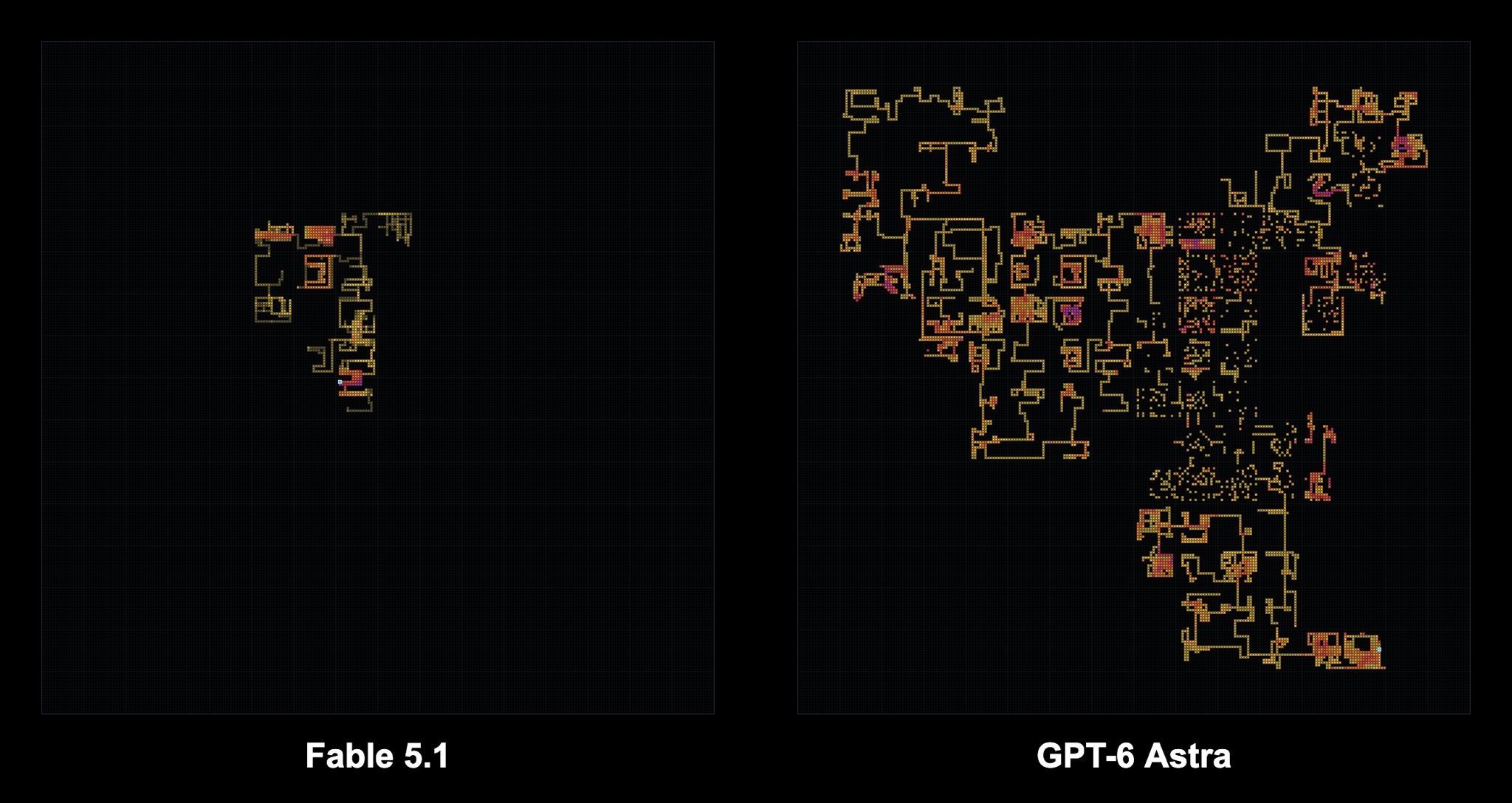
MazeBench exploration maps. Historical ASCII, no-tools run snapshots; conditions differ.
The maps I looked at were snapshots of particular ASCII, no-tools runs, with different resource use, changes to the game, and operator rollbacks. They illustrate different exploration paths, but they do not establish a fair comparison of the models’ capabilities. Without examining the traces, I also can’t rule out a bug or other run-specific problem affecting Fable’s result.
We’re still uncovering what’s different about Astra. If you’re mainly using it to generate code for the same kinds of tasks you do every day, you may not really notice some of what’s changed. MazeBench gives you another way to look at it, and a reason to explore what else might now be within reach.
That brings us to the question of whether frontier models have saturated coding. If you aren’t noticing much improvement in your own coding workflow, how much does that tell you about what has improved in the model overall?
Where progress may (appear to) be flattening
Martin Casado raised this question on September 6:

I think it’s worth looking at the specific task of generating working code. This was one of the earliest applications of LLMs with real-world economic value, and it’s a capability the labs have spent a lot of time developing.
One possible reason is that the people building these models write a lot of software themselves. They’re working to solve their own problem. I’m not saying that’s the only reason coding has received so much attention, but it seems like a plausible part of the explanation.
Coding is also a good domain for LLM development because you can check the results. You can run the code and see whether it passes tests or produces errors. That doesn’t guarantee the code is correct, but it gives you concrete feedback about whether it’s doing what you asked it to do.
But even if models aren’t getting noticeably better at generating working code, there’s much more to the craft of software engineering. There’s system design, collaboration, figuring out what to build, and understanding an unfamiliar codebase. There’s weighing tradeoffs, investigating why something failed, deciding what to try next, and checking whether what you’ve built actually solves the problem. Generating code is one part of that work. A model that can help you with more of the rest could still make a meaningful difference to what you’re able to accomplish.
There’s also the question of how long an agent can maintain coherence while working on a task. Even if it were generating the same quality of code as it was six months ago, it would matter if it could carry a larger piece of work through to completion. Can it keep track of the goal, remember what it’s done, and work through failures without you having to keep bringing it back on track?
That’s the kind of autonomy that makes a difference and isn’t the same thing as directly generating code: being able to complete longer tasks reliably, with less intervention. The work might be the same type of work, but you can entrust more of it to the agent at once. It’s an improvement in depth rather than breadth. So when we’re asking whether models are getting better at software engineering, we also need to ask how much of the work they can help with, and how much of it they can carry through.
Can I now afford to attempt this?
There’s another way a model can bring more within reach. It can give you access to a similar level of frontier intelligence at a lower cost. If the cost of trying something comes down, more people can afford to try it. And someone who already has a budget can use it to attempt more things.
This means you can now consider not just what can I do with the model, but also what can I afford to do with my budget. On Terminal-Bench 4.0, which tests complex work in a terminal, OpenAI reports that Astra scores 57.9%, compared with Fable 5.1’s 55.8%, at approximately 63% lower estimated API cost per task. In that comparison, a modest improvement in performance comes with a much larger reduction in cost.
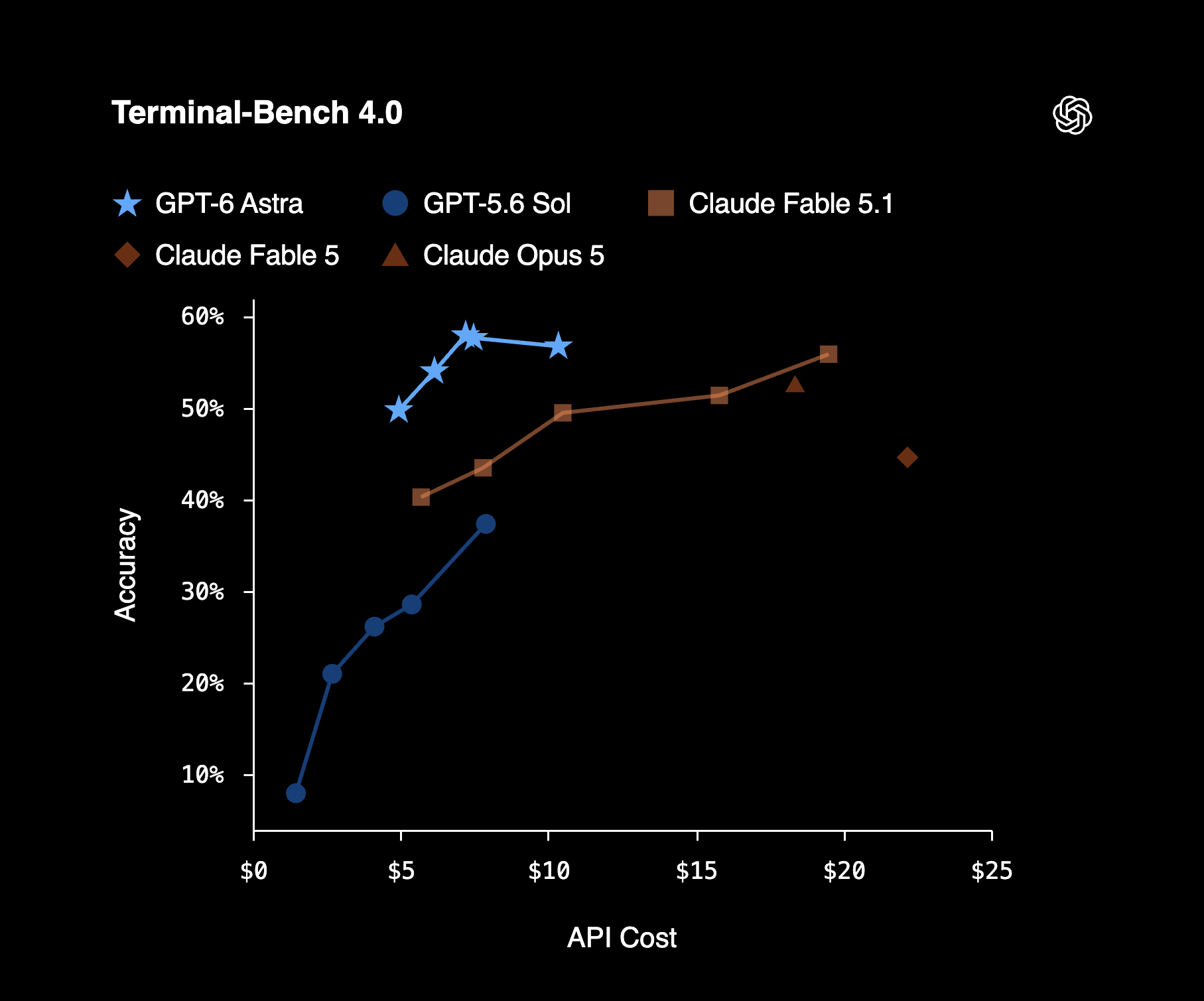
Chart source: OpenAI’s Astra announcement. Estimated API cost per task.
The independent Artificial Analysis results show how big a deal token efficiency is. In its September 9 analysis, Astra and Fable 5.1 both score 53 on the Intelligence Index, but Astra costs $3.26 per task compared with $7.63 for Fable. Astra uses about 27,000 output tokens per task, compared with Fable’s 78,000. These results compare Astra at maximum reasoning effort with Fable at maximum effort with fallback. You get the same aggregate score while paying less than half as much.
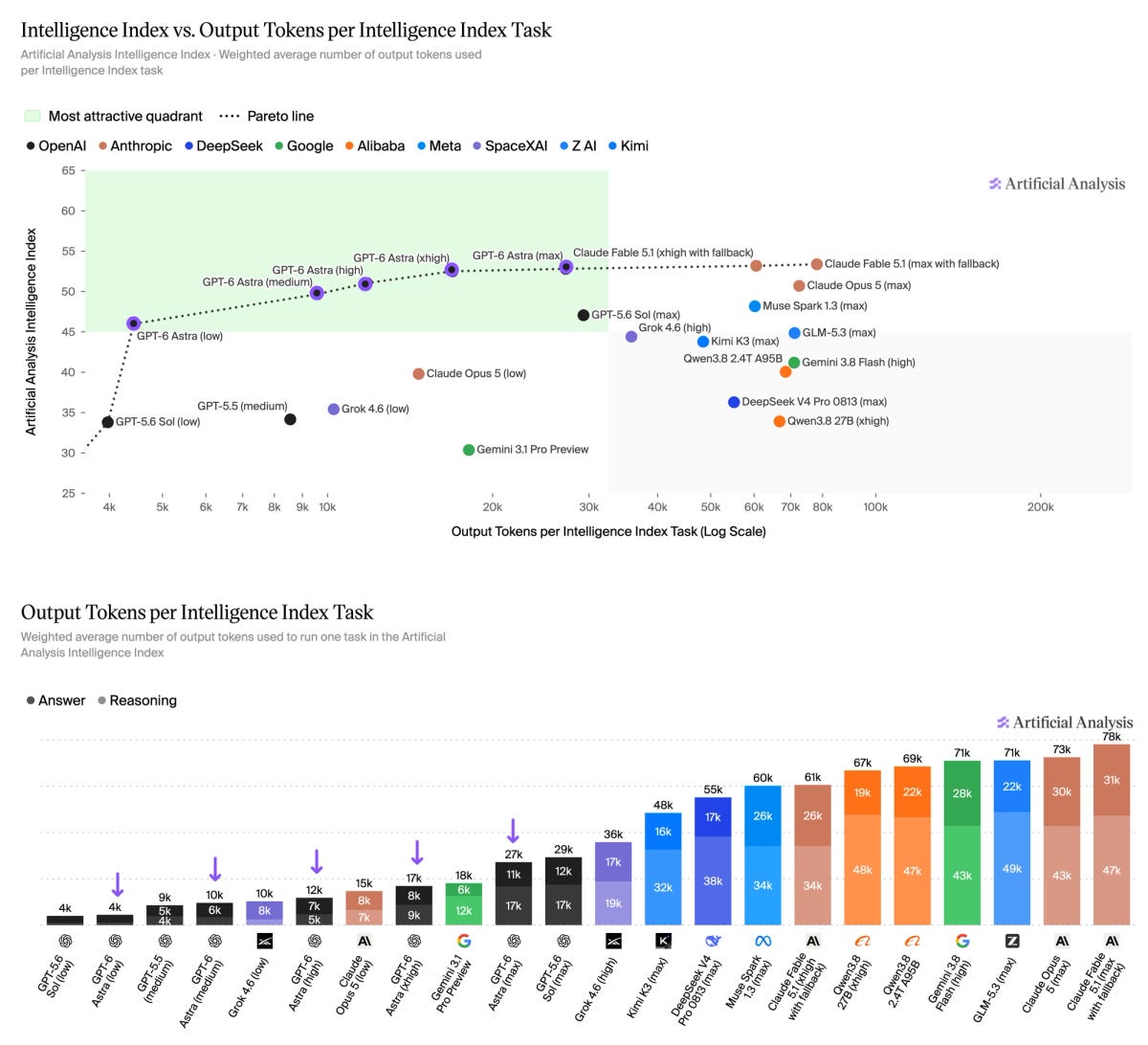
Chart source: Artificial Analysis, September 9. Reasoning configurations differ by model.
ARC-AGI-3 shows something especially interesting: asking a model to reason more can make the whole task cheaper. In ARC Prize’s Standard harness, Astra at high effort scores 54.8%, at a total evaluation cost of $40,705. At maximum effort, it scores 62.7% and costs $26,098. This compares two settings of Astra itself. The benchmark’s authors explain that it solves the games with fewer actions, reducing the number of calls and tokens required. Spending more effort on reasoning can save work later. See ARC Prize’s results.
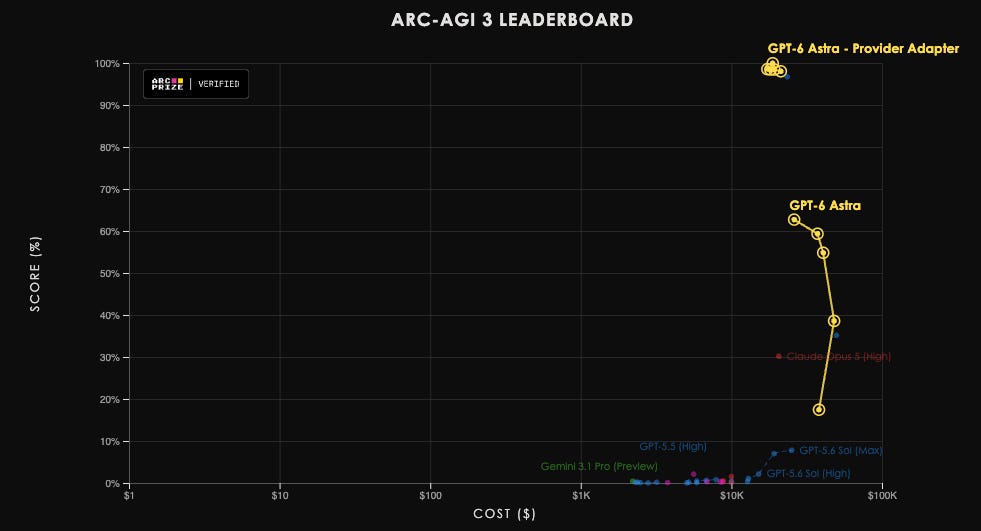
Chart source: ARC Prize. The comparison above uses the Standard harness; Provider Adapter results are a separate configuration.
These are evaluation costs, and a real project also takes human time, review, and retries. Astra isn’t cheaper in every comparison: Artificial Analysis reports higher costs than Sol at maximum effort on both aggregate indices. But the results above illustrate why price per token alone doesn’t tell you what a model will cost to use.
For me, this is another part of raising your ambitions. A project can come within reach because the intelligence needed to help you do it has become more affordable. That lowers the barrier to entry. More people can attempt things, and the same budget can potentially give them more room to experiment, learn, and try again.
A model release is a starting line
“Take our word for it that we have much, much, much more capable models coming soon.”
— Sam Altman, Axios, September 3, 2026
I feel that anticipation whenever a new frontier model is about to arrive. I want to see what it can do, what it can help me do, and what it can help us all accomplish together. But after watching this cycle play out over the past few years, I’ve come to see each release as the beginning of a new phase.
With every new model, there’s work to do: use it, experiment with it, and learn from your own experience where it helps and where it falls short. That’s how you learn what it brings within your reach.
I expect further improvements, though their timing and practical value remain uncertain. I want to keep that possibility in mind when I think about what to build and which ambitions to pursue.
We already have a glimpse of what he means. On September 8, OpenAI announced what it describes as a solution to the Navier–Stokes Millennium Prize Problem, a question about fluid motion that has remained unresolved for roughly 90 years. According to OpenAI, the proof came from an internal model substantially more capable than Astra, working through a system of coordinating agents. The company released a written proof and a Lean formalization. In the same announcement, OpenAI also credited Levent Alpöge and Tristan Buckmaster with a related result on the forced Euler equations, using an internal Anthropic model.
How will you raise your ambition?
What have you always dreamt of doing, but didn’t think you had the resources or support to turn into reality? I would encourage you to try it now, with the support of frontier AI models like Astra and Fable 5.1, and with the expectation that you’ll have access to even more capable models in the future.
My conviction is that this is real. The ability to work with these models is a skill you can develop, and the models themselves are a resource you can use to pursue the things you want to accomplish in your life. That’s something worth investing your time in.
What dream will you now transform into reality?
Wow, that comparison image you shared really shows a difference. Thank you for sharing it!